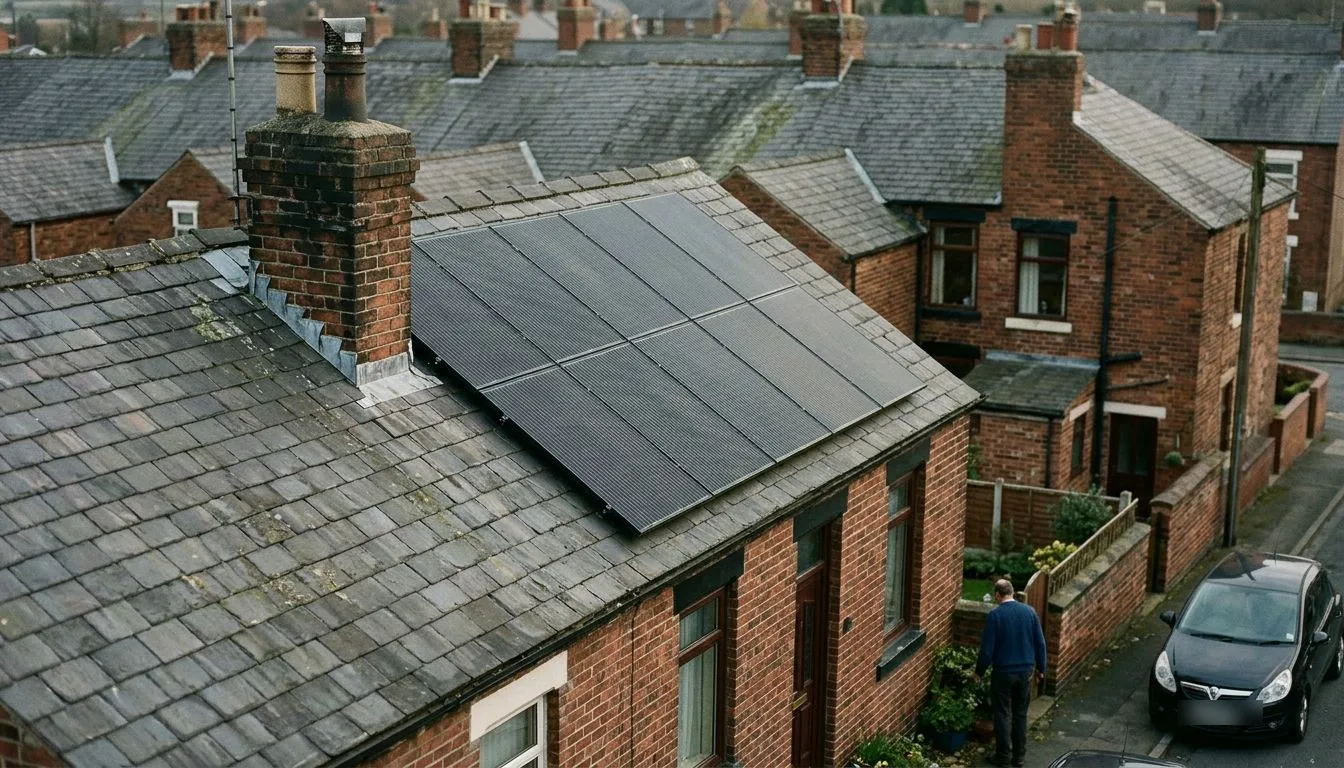
Quick answer: a home solar system has panels, an inverter, a mounting frame and cabling, with an optional battery. Most UK homes fit 3 to 6 kWp, which means 7 to 14 panels and a fitted cost of about £5,500 to £11,000 (October 2026).
How a home solar panel system works
Solar panels contain silicon cells that release electrons when daylight hits them. That creates direct current (DC) electricity. The more light that falls on the cells, the more power they make.
An inverter, usually fitted in the loft or utility room, converts the DC into the alternating current (AC) your appliances use. From there the power flows into your consumer unit, just like power from the grid. Your home uses it first.
Spare power has two routes. You can export it to the grid and earn payments under the Smart Export Guarantee, or you can store it in a battery for later. Panels also work on cloudy days, although they make less.
What a home solar system includes
Every system is designed around your roof, but the main parts are the same. Your installer should list each one in the quote, so you can compare offers like for like.
- Solar panels. Most panels sold for UK homes today convert about 20% to 23% of sunlight to electricity. A typical panel is about 1.76 m by 1.13 m, weighs about 22 kg and is rated at around 430 to 450 W.
- Inverter. A string inverter serves the whole array. Microinverters or optimisers work panel by panel, which helps if part of the roof is shaded.
- Mounting frame and cabling. Brackets and rails hold the panels just above the roof covering. Cables run from the array to the inverter and your consumer unit.
- Meter and monitoring. Export payments need a meter that measures what you send to the grid, normally a smart meter. Most inverters also come with an app that shows daily output.
- Optional battery. A battery stores spare daytime power for the evening. See the battery section below for costs.
- Optional EV charger. If you have an electric car, a charger can use your solar power. Our guide to solar panels and EV chargers explains how.
Types of solar panels
Three panel technologies exist, but one dominates UK homes. Monocrystalline panels are the most efficient mainstream choice, and most quotes use them. Read our guide to the main types of solar panel for a full comparison.
Monocrystalline
Made from single-crystal silicon, these panels have a uniform dark look. They suit most homes, and they make the most power from limited roof space.
Polycrystalline
Made from many silicon crystals, these panels have a blue, speckled look. They need more roof for the same output, so they are now less common on home quotes.
Thin-film
Thin layers on glass, metal or plastic make these panels light and flexible. However, they need the most space, so they mainly suit commercial and specialist jobs.
Solar system sizes and costs
Installers size a system in kilowatts peak (kWp), which is the total rating of the panels. The table shows the common sizes, the roof space each one needs and the typical fitted cost in October 2026. All prices include 0% VAT.
| System size | Panels (430–450 W) | Roof area | Output a year* | Fitted cost |
|---|---|---|---|---|
| 3 kWp | 7 | about 14 m² | about 2,700 kWh | £5,500–£7,000 |
| 4 kWp | 9–10 | 18–20 m² | about 3,600 kWh | £6,500–£8,500 (typical £7,500) |
| 5 kWp | 11–12 | about 22–24 m² | about 4,500 kWh | £7,500–£9,500 |
| 6 kWp | 13–14 | about 26–28 m² | about 5,400 kWh | £9,000–£11,000 |
A typical UK home uses about 2,700 kWh of electricity a year (Ofgem's medium figure). A 4 kWp system makes more than that on our standard assumption, although you use only part of it as it arrives. Bigger systems suit larger households, but extra panels only pay back if you can use or sell the power.
Government figures put the average home retrofit at roughly £1,650 to £2,100 per kW (DESNZ, 2025/26). The 0% VAT rate applies until 31 March 2027, then it goes to 5%. See what solar panels cost and save for the full savings model.
Unsure which size to choose? Read how many panels a typical home needs. You can also estimate your system size with the calculator.
Batteries and home solar systems
A battery stores spare daytime power so you can use it in the evening. Adding a 5 kWh battery at the same time as the panels typically adds £2,500 to £4,000, and a 10 kWh battery typically adds £4,000 to £8,000. A battery bought on its own costs more, because it needs a separate install and often its own inverter.
Since 1 February 2024, home batteries have also been zero-rated for VAT, including batteries added later or installed without solar, until 31 March 2027. Compare current models in our guide to the best solar batteries compared.
On a flat-rate tariff, a battery lengthens payback. Our model shows a 4 kWp system with a 5 kWh battery paying back in typically 15 to 16 years, against about 13 years without one. Batteries pay back faster on a cheap overnight tariff, which this model leaves out.
Roof types, direction and mounting
Most homes have a pitched roof, and panels fix to brackets on the roof structure just above the tiles. Flat roofs normally use tilted frames, because panels laid flat make only about 83% of the best-angle output. Our guide to solar on a flat roof covers frames and weight.
If your roof is shaded or the wrong shape, a garden can help. Ground-mounted solar arrays sit on a frame in the garden. Meanwhile, integrated solar roof tiles replace part of the roof covering and look neater, but they are a specialist option.
Direction matters too. In the UK the best angle is about 35 to 40 degrees, facing due south. Anywhere from 20 to 45 degrees costs you no more than about 4%.
| Roof direction | Output compared with south-facing at 35° |
|---|---|
| South | 100% |
| South-east or south-west | about 93–95% |
| East or west | about 78–80% |
| Flat (no tilt) | about 83% |
| North | about 53% |
East- and west-facing panels make less overall, but they generate more in the morning or evening. A south-facing roof suits most households. Shade from trees, chimneys or neighbouring buildings lowers output further, so a good survey checks it.
How much power will a home solar system make?
For a typical UK roof we assume about 900 kWh per kWp a year, so a 4 kWp system makes about 3,600 kWh. Using the EU's PVGIS model, 1 kWp of south-facing panels at a 35 degree tilt makes about 1,025 kWh in London and about 850 kWh in Glasgow.
Output swings with the seasons. In London, December output is roughly a quarter to a third of June's, and in Glasgow it is under a fifth. For month-by-month figures, see our monthly UK solar output data.
A south-facing roof in southern England can manage 1,000 kWh per kWp or more. However, a shaded or east-west roof in the north may make nearer 750 to 800. Your installer's survey should give a figure for your own roof.
What to expect when a system is fitted
A typical job follows the same steps. A roof system is often fitted in one or two days, but the survey, design and scaffolding come first.
- Home survey. The installer checks your roof, your electrics, shading and where the inverter can go.
- Quote and design. You agree the system size, the equipment and any battery, with each item itemised.
- Scaffolding. Scaffolding goes up so the team can work safely at roof height.
- Panel installation. Installers fit the brackets, panels and inverter, then connect the system to your consumer unit.
- Testing and sign-off. The installer tests the system, explains the monitoring app and hands over the paperwork.
- MCS certificate and export registration. Your MCS-certified installer provides the certificate. You then register with a Smart Export Guarantee supplier to earn for exported power.
Scaffolding, roof complexity and bird-proofing add to the cost, so ask for them to be itemised. Ask the installer to explain anything you do not understand before you sign.
Planning permission for home solar panels
In England, since 27 August 2026, rooftop solar on a house is usually permitted development. Panels can sit no more than 200 mm proud of a pitched roof and no higher than the ridge, or up to 600 mm above a flat roof. They can also go on walls and balconies, within 200 mm where the wall faces a road and 400 mm elsewhere.
Ground-mounted arrays can be permitted development if the panels total no more than 9 m² and stay within height limits. Those limits are 4 m in most of the garden, 2 m within 5 m of the boundary, and 1 m within 5 m of the boundary in front of the house.
Scotland has its own rules, and most rooftop solar on houses is permitted development there if it projects no more than 1 metre. Wales follows its own rules, which England's August 2026 reforms did not change. Northern Ireland's rules are similar to the old English ones: 200 mm, and not above the ridge.
Listed buildings and some conservation-area elevations need consent. Check with your council if your home is listed, in a conservation area, or covered by an Article 4 direction.
Plug-in solar panels
Plug-in solar kits, also called balcony solar, connect through a standard plug and socket. Since 27 August 2026, kits of up to 800 W output that meet the government's product specification can legally be plugged into a normal socket in Great Britain.
You must tell your network operator, normally within 28 days under the G98 process. Use only one kit per home, and never use an extension lead.
In England, plug-in solar is not permitted development on a wooden wall, balcony, fence or gate, or on timber cladding. Renters and leaseholders should get landlord or freeholder consent first. The legal position in Northern Ireland is unclear, so check before you buy. Our plug-in solar panels guide has the details.
Choosing an installer: why MCS matters
The Microgeneration Certification Scheme (MCS) certifies installers and products. An MCS certificate, or an equivalent such as Flexi-Orb, is needed for Smart Export Guarantee payments. It is also needed for Home Energy Scotland and most grant or loan schemes.
Use an MCS-certified installer. Without an MCS certificate you can't get paid under the Smart Export Guarantee. Check the installer's certificate on the MCS website, and make sure they belong to a consumer code.
How long home solar panels last
Panels typically last 25 to 30 years or more. Good modern panels lose roughly half a percent of output a year, so after 25 years they still make around 85 to 90% of their original output.
Expect a product warranty of at least 12 years and a 25 to 30 year performance guarantee, so check the datasheet. You may need to replace the inverter once during the panels' life.
Solar panels by area
Output, planning rules and grants all vary across the UK. Each local guide gives a yield figure from the EU's PVGIS model, plus the rules and schemes that apply in that area. The yield shown is for 1 kWp of south-facing panels at 35 degrees.
- Solar panels in Scotlandabout 870 kWh/kWp
- Solar panels in Walesabout 950 kWh/kWp
- Solar panels in Northern Irelandabout 875 kWh/kWp
- Solar panels in London1,025 kWh/kWp
- Solar panels in Manchester885 kWh/kWp
- Solar panels in Birmingham970 kWh/kWp
- Solar panels in Leeds945 kWh/kWp
- Solar panels in Bristol1,020 kWh/kWp