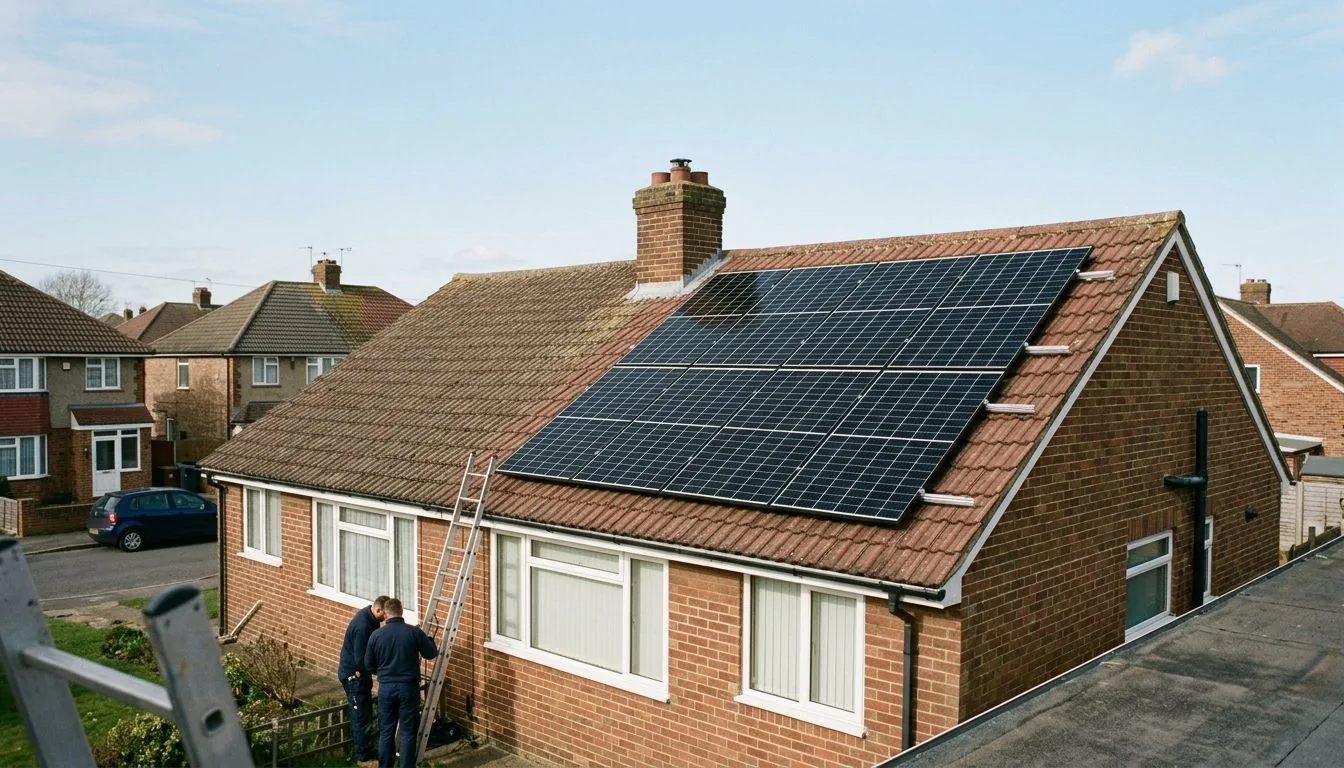
How many solar panels do I need? For most UK homes, the answer is 9 or 10 modern panels. That adds up to a 4 kWp system, which needs about 18 to 20 m² of roof. The exact number depends on how much electricity you use, how much roof you have, and which way it faces.
This guide shows the sums step by step, so you can check any quote you receive.
The quick sums
A typical home panel today is about 1.76 m by 1.13 m. It weighs about 22 kg and is rated at around 430 to 450 W. As a result, a 4 kWp system needs 9 to 10 panels.
For a typical UK roof, we assume about 900 kWh of output per kWp each year. So a 4 kWp system makes about 3,600 kWh a year. A south-facing roof in southern England can manage 1,000 or more, while a shaded or east-west roof in the north may give nearer 750 to 800.
Compare that with a typical home, which uses about 2,700 kWh of electricity a year (Ofgem’s medium figure).
Sources: Ofgem typical domestic consumption values; EU PVGIS solar model.
Panels by system size
Use this table as a guide. Costs are typical fitted prices for October 2026, including 0% VAT, and exclude a battery.
| System | Panels (430 to 450 W) | Roof area | Output per year (at 900 kWh per kWp) | Typical cost |
|---|---|---|---|---|
| 3 kWp | 7 | about 14 m² | about 2,700 kWh | £5,500 to £7,000 |
| 4 kWp | 9 to 10 | 18 to 20 m² | about 3,600 kWh | £6,500 to £8,500 |
| 5 kWp | 11 to 12 | 22 to 24 m² | about 4,500 kWh | £7,500 to £9,500 |
| 6 kWp | 13 to 14 | 26 to 28 m² | about 5,400 kWh | £9,000 to £11,000 |
So a 3 kWp system roughly matches a typical home’s yearly use. However, you will not use every unit as it is made. On our standard model, about 30% of the output is used in the home, and the rest is exported. See what fitting solar panels costs for the price detail by size.
Sources: DESNZ solar PV cost data; HMRC VAT guidance.
A simple formula
You can size a system in three steps:
- Take your yearly use in kWh from your bill.
- Divide by the yield, 900 for a typical roof.
- Divide by the panel size in kW, for example 0.44.
For example, 3,600 kWh divided by 900 gives 4 kWp. Divided by 0.44 kW per panel, that is about nine panels. For a quicker answer, try estimating your system size with the calculator. For more on solar panel systems for homes, see our overview.
Check your roof space
Next, work out how many panels your roof can hold. Measure the south-facing part first, or the south-east and south-west parts. Chimneys, roof windows and vents all take space, and installers also leave gaps near the edges.
Each panel needs about 2 m² of roof once you include the gaps. A 4 kWp system therefore needs 18 to 20 m². If your roof is small, a higher-wattage panel can help you reach the same output with fewer panels.
How direction changes the number
If your roof does not face south, each panel makes less. In London, the EU’s PVGIS model gives these figures compared with a south-facing 35° roof:
| Roof direction | Output compared with south |
|---|---|
| South-east or south-west | about 93 to 95% |
| East or west | about 78 to 82% |
| North | about 53% |
You can offset this with extra panels. For example, a west-facing roof might need about a quarter more panels to match a south-facing one. Our guide to monthly UK solar output data shows how generation varies through the year.
Where you live matters
Yield also changes across the country. In PVGIS, 1 kWp facing south at 35° makes about 1,025 kWh a year in London and about 1,020 in Bristol. In Glasgow it is about 850.
So a home in the north or in Scotland needs more panels than one in the south for the same output. See what solar generates in Scotland and solar panels in Bristol for the local figures. More panels also cost more, so see what solar panels cost and save before you settle on a size.
When you might need more panels
Several things can push the number up:
- An electric car. Charging at home adds a lot of demand. Read about charging an EV from solar.
- A heat pump. A typical home with one uses roughly 3,500 kWh a year more, though this is an estimate. See solar panels for a heat pump.
- Working from home. Daytime use means you use more of your own power.
- A battery. It stores spare power, so a larger array may make sense. Compare the best solar batteries.
Note that solar panels cannot cover a heat pump in winter. December output is only about a quarter to a third of June’s, so size for yearly use, not winter use.
Frequently asked questions
Is there a maximum number of panels?
There is no set limit on panel count. In England, rooftop panels are usually permitted development if they stay within 200 mm of a pitched roof slope. Your installer will also tell the local network operator about the system.
Do more panels always save more money?
Not always. Once you make more than you can use, extra panels mainly add exports, which pay a modest rate. For a home without a battery, a bigger system pays back more slowly.
Can I add panels later?
You can, but it is often dearer than fitting them all at once. You may need scaffolding again and possibly a bigger inverter. If your roof has room, plan the full system at the start.
Are fewer, larger panels better?
Usually yes. They need less racking and fewer connections. Look at the panel’s efficiency, which is typically about 20 to 23% for modern home panels.
What if part of my roof is shaded?
Shade can cut output a lot. Microinverters or power optimisers help, because each panel then works on its own. Ask your installer for a shading report.
Ready to size your own system? Get free quotes and compare.