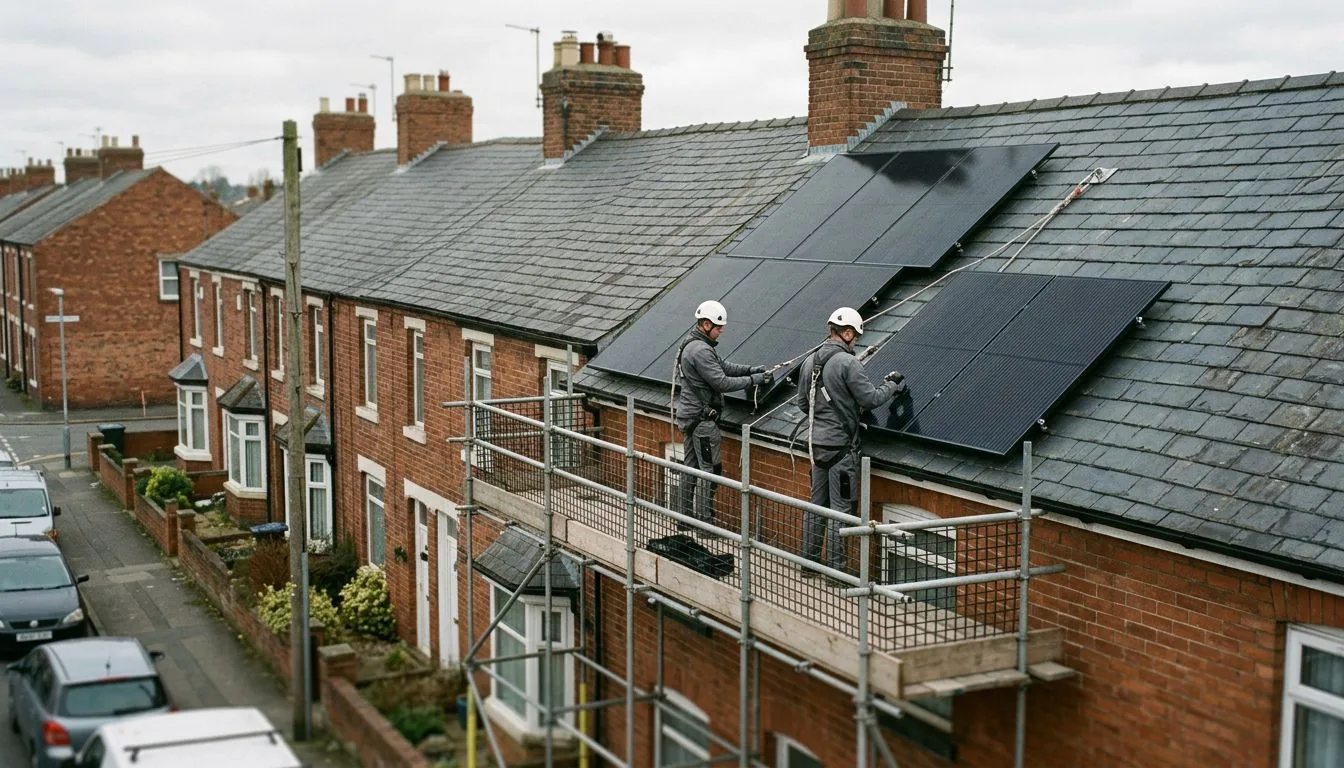
Solar panels cost between about £5,500 and £11,000 for most UK homes, depending on system size. A typical 4 kWp system costs about £6,500–£8,500 fitted, although every roof is different. This guide gives the house solar panels price for each size, shows what drives the fitting cost, and explains how to compare quotes.
All prices are as at October 2026, and they can change. They include 0% VAT, which applies until 31 March 2027.
How much do solar panels cost by system size?
These are our house ranges for a fully installed system without a battery. They draw on UK government cost data, which is based on MCS installs, plus published installer price guides. As a result, they are a fair guide.
| System size | Panels (at 430–450 W) | Installed cost (0% VAT) |
|---|---|---|
| 3 kWp | 7 | £5,500–£7,000 |
| 4 kWp | 9 or 10 | £6,500–£8,500 (typical £7,500) |
| 5 kWp | 11 or 12 | £7,500–£9,500 |
| 6 kWp | 13 or 14 | £9,000–£11,000 |
| 4 kWp plus 5 kWh battery, fitted together | 9 or 10 | £10,000–£14,000 (typical £11,500) |
The 6 kWp range rests on one data source. However, treat it as a guide. Still not sure which size you need? Use our solar panel calculator to size your system first.
Cost per kW: what the government data shows
The Department for Energy Security and Net Zero (DESNZ) publishes solar cost data from MCS installs. Its 2025/26 figures, for example, cover a record of more than 260,000 installs in Great Britain.
| Size band | Domestic retrofit, mean (£ per kW) | All installs, median (£ per kW) |
|---|---|---|
| 0–4 kW | £2,109 | £1,595 |
| 4–10 kW | £1,651 | £1,546 |
In short, a typical home retrofit costs about £1,650–£2,100 per kW. Smaller systems cost more per kW, because fixed costs such as scaffolding and the inverter are spread over fewer panels. Median cost per kW fell by 7–9% in real terms against 2024/25.
What drives the solar panel fitting cost
Several things push a quote up or down, so it helps to know them. Understanding them helps you compare like with like.
- System size. More panels cost more in total, but less per kW.
- Roof type and access. A complex roof takes longer. Scaffolding adds to the bill, and so does a roof that needs extra work to fit the mounting.
- Panel and inverter brand. Premium panels and microinverters cost more than standard ones.
- Extras. Bird-proofing and panel-level optimisers add to the price. Our guide to pigeon-proofing solar panels explains why bird-proofing is worth pricing in.
- Battery storage. A battery is the biggest single add-on. More below.
- Region. In the DESNZ data, London is the most expensive region, with a mean of £2,101 per kW for 0–4 kW installs. Scotland averages £1,767 per kW in the same band. Wales averages £1,424 per kW for 4–10 kW installs.
Your roof shape also matters, since access changes the labour. Read about flat roof mounting options if yours is not pitched. For a sense of what London homes can generate, see what solar generates in London and solar panels in Scotland.
Adding a battery
While prices vary, a battery fitted with new panels typically adds £2,500–£4,000 for 5 kWh. A 10 kWh battery typically costs £4,000–£8,000, or about £400–£700 per kWh of usable capacity.
A battery added later costs more, because it needs a separate visit and often its own inverter. Since 1 February 2024, home batteries have also been zero-rated for VAT, including ones added later, until 31 March 2027. See our guide to adding battery storage for the full picture.
VAT on solar panels: 0% until 31 March 2027
Solar panels fitted to homes are zero-rated for VAT until 31 March 2027, but after that the rate goes to 5%. On a typical 4 kWp system, the zero rate saves roughly £300–£400 compared with the old 5% rate.
Because the 5% rate returns on 1 April 2027, a quote signed this winter may be cheaper than one signed next spring. Check the date your installer will invoice, not only the date you sign.
Sources: HMRC VAT guidance on energy-saving materials; DESNZ solar PV cost data.
What a quote should include
A fully installed quote should list each of these items, because gaps in a quote often become extra charges.
- Panels: the brand, model, rated wattage and warranty.
- Inverter: the brand, size and warranty.
- Mounting system and cabling: fitted to your roof type.
- Network operator notification: your installer handles this.
- MCS certificate: you need it to be paid under the Smart Export Guarantee.
- Monitoring: an app, normally, that shows your generation.
Since the price covers a whole job, read how an installation works step by step. It shows what the price covers.
Is the spend worth it?
On our standard model, a 4 kWp system costing about £7,500 saves and earns roughly £590 a year at October 2026 prices. That means it pays for itself in about 13 years, or roughly 11–15 years depending on price, roof and export tariff.
Over 25 years, the system returns about £13,800, which is about £6,300 more than it cost. Our guide to how long solar takes to break even shows the sums. For the full picture, read whether solar panels are worth it in the UK or see solar panel costs and savings in the UK.
Help with the cost
Although there is no general solar grant for most households, some help exists. ECO4 closes on 31 December 2026, and installers are finishing existing jobs, so do not plan on it for a new project. The government’s Warm Homes Plan promises low-interest loans, but most of it opens from 2027.
However, Home Energy Scotland no longer funds standard solar panels. See current UK solar funding schemes for what applies where you live.
How to compare quotes
Get at least three quotes from MCS-certified installers, and check each is a member of a consumer code. Compare the same system size, the same panel wattage and the same battery, because otherwise the totals mislead.
Look at the price per kW, not only the total. Still, check the warranties too, since they differ. Expect a product warranty of at least 12 years and a 25–30-year performance guarantee, and check the datasheet. When you are ready, request free quotes from local installers.
Frequently Asked Questions
Q: Is there VAT on solar panels in the UK? A: Not at the moment. Solar panels fitted to homes are zero-rated for VAT until 31 March 2027, and the rate then goes to 5%. The zero rate saves roughly £300–£400 on a typical 4 kWp system.
Q: Are there grants to reduce the cost of solar panels? A: There is no general grant for most households. ECO4 ends on 31 December 2026 and was only ever for eligible low-income homes. Check your council, and see our solar grants page for the latest.
Q: How much does a 4 kWp solar system cost? A: About £6,500–£8,500 fully fitted, with a typical price near £7,500. That is nine or ten panels. A 5 kWh battery fitted at the same time adds about £2,500–£4,000.
Q: Do I need planning permission? A: In England, since 27 August 2026, rooftop solar on a house is usually permitted development. Panels must not stand more than 200 mm proud of a pitched roof or rise above the ridge. Check with your council if your home is listed, in a conservation area, or covered by an Article 4 direction. Scotland, Wales and Northern Ireland have their own rules.
Q: What warranty should I expect? A: Expect a product warranty of at least 12 years and a performance guarantee of 25–30 years. Inverters and batteries carry their own warranties, so ask for each in writing. You may need to replace the inverter once during the panels’ life.