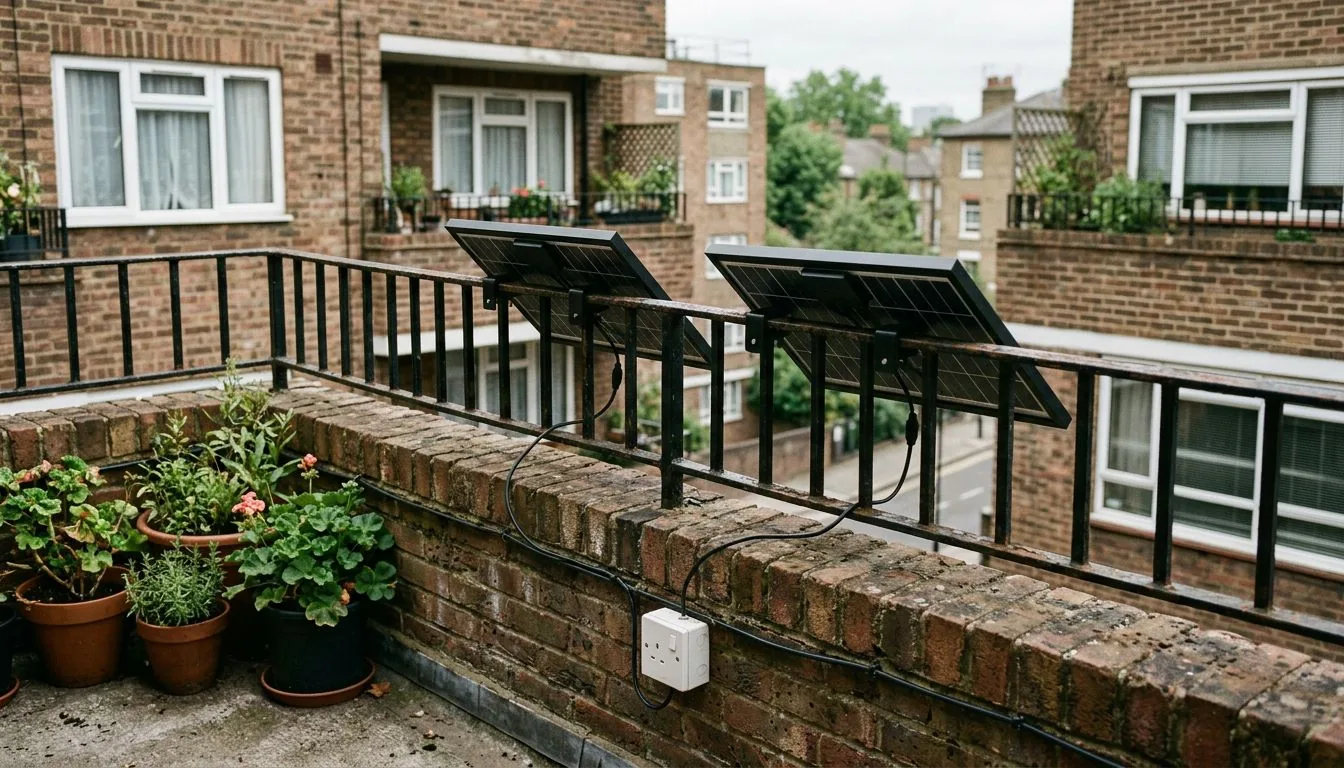
Plug-in solar panels are small solar kits that you plug into a normal socket. Since 27 August 2026 they are legal in Great Britain. This guide explains the rules, the output and the savings, so you know what to expect before you buy.
Plug-in solar panels UK: what they are
A plug-in kit has one or two panels and a small inverter. The inverter turns the panels' direct current into mains power. A plug carries that power into your home's wiring.
Names vary. You will also see balcony solar, micro solar and plug-and-play solar. They all mean the same idea. For the buying side, read our guide to small plug-and-play systems.
Germany led the way here. Its official register shows more than 1.32 million registered units as at May 2026. Britain is now catching up.
Are plug-in solar panels legal in the UK?
Yes. The Plugs and Sockets etc. (Safety) Regulations 1994 and Electricity Safety, Quality and Continuity Regulations 2002 (Amendment) Regulations 2026 came into force on 27 August 2026. Lawyers call it SI 2026/848. It allows a kit to be plugged into a standard socket.
The rules cover England, Wales and Scotland. In Northern Ireland the legal position is unclear, so check before you buy.
- 800 W limit. A kit may have a maximum AC output of 800 W.
- 2,000 W of panels. The total panel power must not exceed 2,000 W. Above 960 W, makers advise a professional check of the wiring.
- One per home. Current network rules allow one plug-in device per household.
- Product standard. The kit must meet the government's Plug-in Solar Device Interim Product Specification.
Sources: SI 2026/848, legislation.gov.uk, DESNZ plug-in solar specification and response, GOV.UK.
What you must do when you plug in
First, tell your network operator. The network operator owns the cables in your street. It is not your energy supplier. Notify it under the G98 process, normally within 28 days. You can find your operator at energynetworks.org.
Next, follow the product rules. Never use an extension lead, and never daisy-chain kits. Your socket circuit also needs RCD or RCBO protection. Because wiring varies in older homes, Electrical Safety First recommends having an electrician check it.
If you rent or own a leasehold flat, get consent from your landlord or freeholder first. This is the government's advice in its July 2026 response.
How much power will a plug-in kit make?
Output depends on the size of your panels and where they face. For a typical UK roof, we assume about 900 kWh per kWp a year. A kit with two 400 W panels is 0.8 kWp. It would therefore make about 720 kWh a year.
Direction matters a lot. The table uses London figures from the EU's PVGIS solar model.
| Facing | Share of best output |
|---|---|
| South, 35 degrees | 100% |
| South-east or south-west | About 93% to 95% |
| East or west | About 78% to 82% |
| Flat | About 83% |
| North | About 53% |
Seasons matter too. December output is roughly a quarter to a third of June's. As a result, most of the benefit comes between spring and early autumn. A panel fixed upright on a balcony rail makes less than one at a tilt, so expect the lower end.
Sources: PVGIS, European Commission.
How much can a plug-in kit save?
Under Ofgem's price cap for October to December 2026, electricity costs an average of 26.32p per kWh. That figure has no VAT in it for this period. A kit making 720 kWh would save about £190 a year if you used every unit yourself.
You will not use every unit. For example, if you use about half, the saving is about £95. The rest flows to the grid unpaid. Our calculation is only a guide, and your use will differ.
The cap changes every quarter. Ofgem announces the January to March 2027 cap by 25 November 2026. Use the solar panel calculator to size a larger system.
Sources: Ofgem price cap notice.
Planning permission for plug-in panels
In England, plug-in solar now counts as solar PV for permitted development. Since 27 August 2026, panels can usually go on walls and balconies. They may protrude up to 200 mm where the wall faces a road, and 400 mm elsewhere.
However, there are limits. Plug-in solar is not permitted development on a wooden wall, balcony, fence or gate. It is also barred on timber cladding. Listed buildings need consent, and conservation areas need a check with your council.
Scotland and Wales keep their own rules. In flats in solar panels in London and what solar generates in Manchester, cladding and balcony type often decide the answer. Our guide to planning permission for solar has more detail.
Sources: SI 2026/896, legislation.gov.uk.
Plug-in solar or a rooftop system?
A plug-in kit is cheap and portable. It suits flats and rented homes. However, it is small, so it only trims your bill.
A full rooftop system is a bigger job. A typical 4 kWp system costs about £6,500 to £8,500 fitted (October 2026), with 0% VAT until 31 March 2027. See what solar panels cost and save for the full sums. On our standard model it pays back in about 11 to 15 years, typically 13. See a full breakdown of installation prices and our residential solar panels overview.
A plug-in kit has no battery. If you want storage, see best solar batteries compared. For the wider picture, read our home solar guide.
Flats, renters and DIY
Flats are a main use for plug-in kits. Check your lease for rules about the outside of the building. Renters need written consent. Our guide to solar options for flats and rented homes goes further.
You may also ask what you can fit yourself. A compliant kit is designed for self-install. For other work, see what you can legally install yourself.
Export payments and the Smart Export Guarantee
Without an MCS certificate you cannot be paid under the Smart Export Guarantee. Plug-in kits generally do not have one. Therefore, the value comes from using the power yourself.
Surplus power flows to the grid. You are not paid for it. That is why daytime use, such as a washing machine run at noon, matters.
Sources: Smart Export Guarantee, GOV.UK.
Frequently asked questions
Are plug-in solar panels legal in the UK?
Yes, in Great Britain. SI 2026/848 came into force on 27 August 2026. A kit with up to 800 W AC output that meets the government's product specification can be plugged into a normal socket. The position in Northern Ireland is unclear, so check before you buy.
Do I need to tell my network operator?
Yes. Notify your network operator under the G98 process, normally within 28 days. It is a notification, not an approval. You must also use only one kit per home and never use an extension lead.
What is the biggest plug-in system I can have?
The maximum AC output is 800 W. The total panel power must not exceed 2,000 W. Above 960 W of panels, makers advise a professional check of the wiring.
Can I use plug-in solar in a flat or a rented home?
Often yes, but get consent from your landlord or freeholder first. In England, plug-in solar is not permitted development on a wooden wall, balcony or timber cladding. Check your lease and your council's rules.
Can I take plug-in panels with me when I move?
Usually yes, if the mounts leave no permanent fixings. You would need to notify the network operator at your new address. Check that the kit still meets the product specification.
Do plug-in panels earn export payments?
Generally not. Without an MCS certificate you cannot be paid under the Smart Export Guarantee. The saving comes from using the power in your own home.
Sources: SI 2026/848, DESNZ plug-in solar pages, Ofgem.