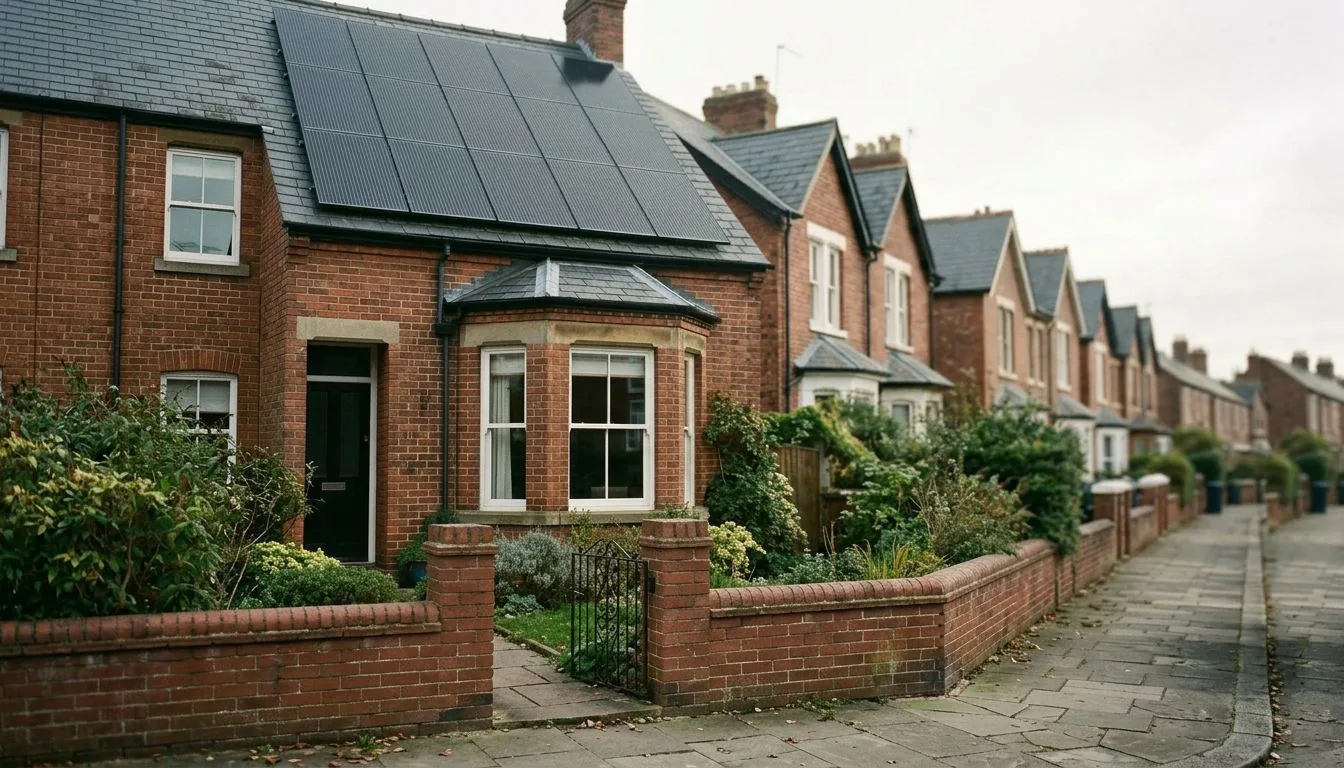
Do you need planning permission for solar panels in the UK? For most homes, the answer is no. Rooftop panels are usually “permitted development”, which means the law already gives you the right to fit them.
The details differ by nation, though. England changed its rules on 27 August 2026, and the other three nations did not follow. This guide sets out each set of rules in plain English.
What permitted development means
Permitted development (PD) is a national grant of planning permission. If your project fits the rules, you do not need to apply to your council. If it breaks even one rule, you must apply.
PD rules only cover planning. They do not replace the electrical safety rules, so a qualified installer still has to do the work. For a sense of how a job runs, see what happens on installation day.
PD also comes with conditions that carry on from older rules. You must site panels to keep their effect on appearance and amenity as small as you can. You must also remove them when they are no longer needed.
Planning permission for solar panels in England
England’s rules changed with the Town and Country Planning (General Permitted Development) (England) (Amendment) Order 2026, which took effect on 27 August 2026. For a house, rooftop solar is now usually permitted development. The limits are simple:
- Pitched roof: panels must stick out no more than 200 mm from the roof slope, and sit no higher than the highest part of the roof (chimneys excluded).
- Flat roof: the highest part of the panels can be up to 600 mm above the highest part of the roof.
- Walls: up to 200 mm out if the wall faces a road, and 400 mm otherwise.
- Balconies and roof edges: the same 200 mm and 400 mm limits apply to a balustrade, railing or parapet. This is new.
Panels on walls and balconies are a real change. A suitable wall or balcony can now count as well as the roof.
Sources: The 2026 Order on legislation.gov.uk.
Where England still needs consent
Some homes sit outside the new rules. First, listed buildings and scheduled monuments fall outside the rules, so you need consent. Second, in a conservation area or World Heritage Site, panels on a wall, balcony or roof edge that faces a road fall outside permitted development.
Roof panels in a conservation area are no longer barred just because they face the road. However, you should still check with your council before you order anything.
Councils can also issue an Article 4 direction. This is a local order that removes permitted development rights in a defined area. Ask your council whether one covers your street, especially if you live in an older terrace. See London solar costs and support for how conservation areas and flats shape the picture in a big city.
Check with your council if your home is listed, in a conservation area, or subject to an Article 4 direction. A short call or email now is cheaper than removing panels later.
Flats and plug-in solar
Blocks of flats follow separate rules. PD does not apply if the block has listed status. Leaseholders also need the freeholder’s agreement, because the roof and walls are not theirs.
Plug-in (balcony) solar is now named in the rules as solar PV. However, it falls outside permitted development on a wooden wall, balcony, fence or gate, or on timber-clad walls. Our guide to solar options for flats and rented homes covers these cases in more detail.
Renters and leaseholders should get consent from the landlord or freeholder first.
Ground-mounted panels in England
A stand-alone array in your garden can also fall under permitted development. The total panel area must be no more than 9 m², and the height limits are:
- 4 m in most of the garden;
- 2 m if it sits within 5 m of the boundary;
- 1 m if it sits within 5 m of the boundary and in front of the house.
A conservation area, listed building or scheduled monument brings extra limits. In a conservation area, an array nearer the road than the house needs prior approval from the council. For more on layouts and costs, read about ground-mounted solar arrays.
We read the new text this way, but the official guidance was not available to us in full. So check the limits with your council before building.
Transition period
Some work fell under permitted development before 27 August 2026 but does not meet the new rules. You may still carry it out until the end of 26 August 2027. After that, the new rules apply.
Scotland
Scotland has its own rules, and England’s 200 mm limit does not apply. Most rooftop solar on houses falls under permitted development if it projects no more than 1 metre from the wall or roof surface.
Since 2024, that can include rear elevations in conservation areas, and side elevations that do not face a road. Panels on outbuildings can stick out 200 mm from a wall or pitched roof, and 500 mm from a flat roof.
Flats have a separate class, which does not apply in a conservation area or the grounds of a listed building. See solar panels in Scotland for yields and funding.
Sources: Scottish Government Planning Circular 1/2024.
Wales
Wales still follows its own order, and England’s August 2026 reforms did not change it. Roof and wall panels must stick out no more than 200 mm, and sit no higher than the ridgeline. On a flat roof, panels must be at least 1 m from the roof edge and no more than 1 m above the roof.
In a conservation area or World Heritage Site, you need consent for panels on a main or side wall facing a road. You can fit one stand-alone array, up to 4 m tall (2 m within 5 m of the boundary), at least 5 m from the road, and 9 m² in total. Read more about solar panels in Wales.
Sources: Welsh Government guidance on roof and wall-mounted solar panels.
Northern Ireland
Northern Ireland’s rules look like the old English ones. Panels on a house can stick out no more than 20 cm, and must not rise above the highest part of the roof. You can fit one stand-alone array, up to 4 m tall.
The “minimise the effect on appearance” and “remove when no longer needed” conditions apply here too. We have only partly verified these details, so check with your council planning office before starting. You can also see what solar generates in Northern Ireland.
Sources: The 2015 Order as amended, on legislation.gov.uk.
Roof tiles and other special cases
Integrated products such as solar slates and tiles are still solar PV. So the same projection and listing rules apply, but the finish matters more in a conservation area. Read our guide to integrated solar roof tiles for costs and trade-offs.
What to do next
First, work out which nation you are in. Next, check whether your home is listed, in a conservation area, or subject to an Article 4 direction. Your council’s planning website usually has a map.
Then ask installers to confirm in writing that your plan fits permitted development. A good installer will know the local position. Use an MCS-certified installer, because without MCS you cannot get paid under the Smart Export Guarantee. See our overview of residential solar panels for how a full system fits together.
If you want quotes, get free quotes from local installers. We connect homeowners with installers, and we are not a planning adviser.
Frequently asked questions
Do I need planning permission for solar panels on my roof?
Usually not. In England, rooftop panels on a house are normally permitted development if they stick out no more than 200 mm and sit below the ridge. Listed buildings need consent, and conservation areas have extra limits.
Are the rules the same in Scotland, Wales and Northern Ireland?
No. Each nation has its own rules, and England’s August 2026 changes do not apply elsewhere. Scotland allows up to 1 m of projection, while Wales and Northern Ireland use a 200 mm limit.
Do I need planning permission in a conservation area?
Not always. In England, roof panels there are no longer barred just for facing the road. However, panels on a wall, balcony or roof edge that faces a road fall outside permitted development, so check with your council.
Can I put solar panels on my garden or on the ground?
Yes, in England, if the panels total no more than 9 m² and meet the height limits. Wales and Northern Ireland allow one stand-alone array. Always check local limits first.
What is an Article 4 direction?
It is a council order that removes permitted development rights in a set area. If one covers your street, you must apply for planning permission even for work that normally needs no application. Ask your council.
Do flats and rented homes need permission?
Flats follow separate rules, and you need the freeholder’s consent. Renters should get written consent from their landlord before fitting anything.