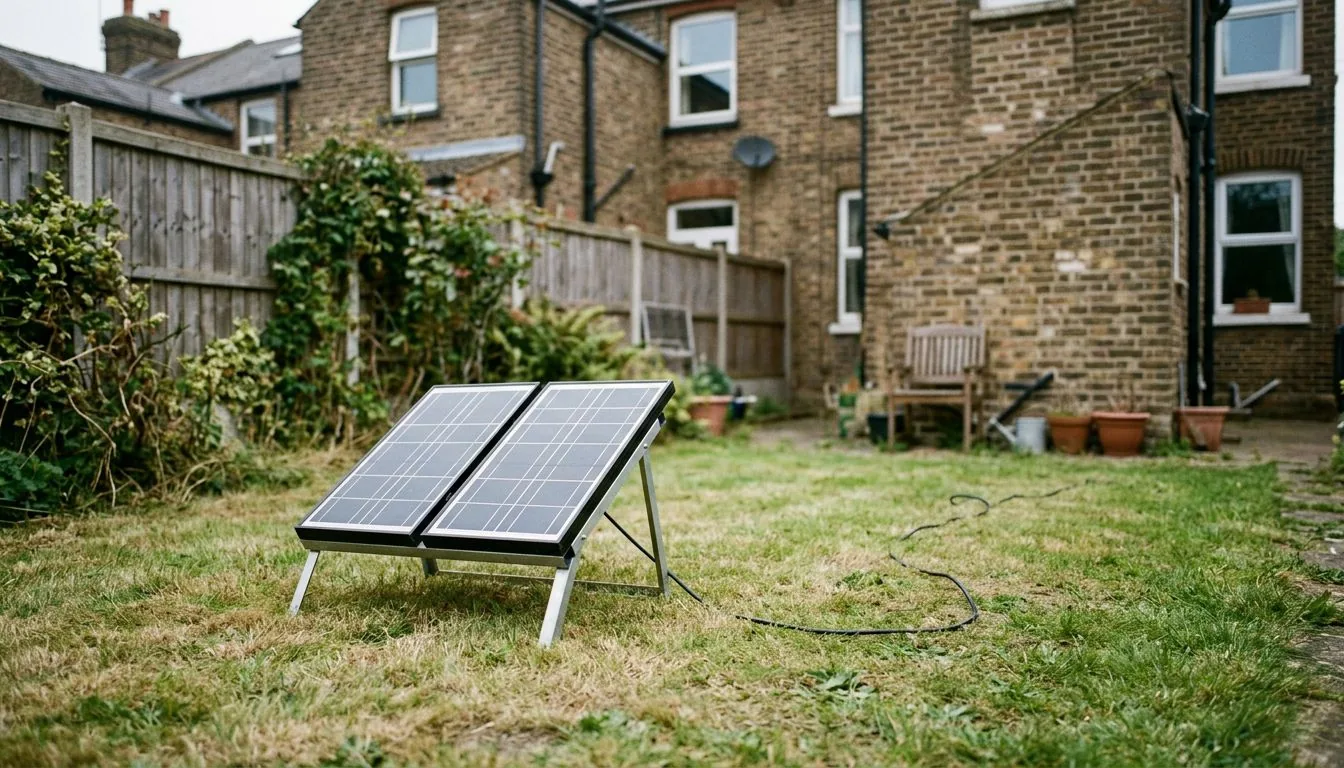
Plug-and-play solar panels UK buyers can now use legally have changed the rules in 2026. A small kit can plug into a normal socket in Great Britain. This page covers the legal timeline, the checks to make and how to buy safely.
Plug-and-play solar panels UK: the 2026 timeline
Plug-and-play, plug-in and balcony solar all describe the same idea. One or two panels feed a small inverter, which feeds a plug. For output and savings, see our guide to plug-in solar panels.
- 16 July 2026: the government made SI 2026/848. It also published its response and version 2 of the product specification.
- 27 August 2026: the regulations came into force in Great Britain.
The law is SI 2026/848. Its full title is the Plugs and Sockets etc. (Safety) Regulations 1994 and Electricity Safety, Quality and Continuity Regulations 2002 (Amendment) Regulations 2026. The plug approval applies UK-wide, but the permission to operate covers England, Wales and Scotland only.
Sources: SI 2026/848, legislation.gov.uk, DESNZ plug-in solar pages, GOV.UK.
What the rules allow
Since 27 August 2026, plug-in solar kits of up to 800 W output that meet the government's product specification can legally be plugged into a normal socket in Great Britain. The kit must carry that specification, and the plug itself must be approved. However, the rules do not cover kits above the limit.
- Power: maximum 800 W AC output.
- Panels: up to 2,000 W of panel power in total.
- Wiring check: above 960 W of panels, makers advise a professional check.
- One per home: current network rules allow one device per household.
The 800 W figure is the inverter's output, not the panel rating. Two 400 W panels therefore fit well. Northern Ireland is different, because the legal position there is unclear.
Tell your network operator
You must notify your network operator. It owns the cables on your street. Use the G98 process, normally within 28 days. The form is free, and you can find your operator at energynetworks.org.
The product must come with instructions on this. You must also keep to two other rules. Never use an extension lead or chain kits together, because the rules forbid it. Your circuit also needs RCD or RCBO protection.
How to buy a kit safely
Choose a kit that states it meets the government's product specification. Check that the plug is approved. Cheap imports may break the rules, since they often lack this paperwork.
- Look for a statement of compliance with the specification.
- Check the inverter output is 800 W or less.
- Read the instructions, including how to notify your operator.
- Buy from a retailer with clear UK returns and support.
- Ask an electrician to check your wiring if your home is old. Electrical Safety First advises this.
We do not print kit prices because they change often and vary by brand. Therefore, compare several offers.
Renters and flats
A plug-in kit suits renters because you can take it with you. However, you should get consent from your landlord or freeholder first. That is the government's advice.
Local conditions vary too. See what solar generates in Birmingham and Leeds solar costs and support for two areas with many rented homes. While you are there, read balcony solar for flats.
Planning matters on balconies. In England, plug-in solar is not permitted development on a wooden wall, balcony, fence or gate, or on timber cladding. Check with your council if your home is listed, in a conservation area, or covered by an Article 4 direction.
Sources: SI 2026/896, legislation.gov.uk.
What a kit can and cannot do
A kit of 0.8 kWp makes about 720 kWh a year on a typical roof, using our 900 kWh per kWp assumption. At Ofgem's October to December 2026 cap of 26.32p per kWh, that is worth about £190 if you use every unit. Since you will use only part of it, expect less.
Plug-in kits generally have no MCS certificate. Without an MCS certificate you cannot be paid under the Smart Export Guarantee. So the value is in self-use.
If you want a bigger saving, a full system does more. A typical 4 kWp system costs about £6,500 to £8,500 fitted (October 2026), with 0% VAT until 31 March 2027. See what solar panels cost and save for the full sums. Size one with our solar panel calculator. See also solar panel systems for homes.
Sources: Ofgem price cap notice, DESNZ solar PV cost data.
Next steps: DIY, storage and rooftop options
Makers design plug-in kits for self-install, although other work is different. Read DIY solar in the UK to see where the line falls.
Kits like this have no battery. If you want to add storage later, see how the leading home batteries compare. For a rooftop system, start with home solar panel systems explained.
Frequently asked questions
Are plug-and-play solar panels legal in the UK?
Yes, in Great Britain. SI 2026/848 came into force on 27 August 2026. A kit of up to 800 W output that meets the government's product specification can be plugged into a normal socket. The position in Northern Ireland is unclear.
What is the 800 W limit?
It is the maximum AC output of the inverter. The total panel power may be up to 2,000 W. Above 960 W of panels, makers advise a professional check of the wiring.
Can I plug a kit into any socket?
Use a normal wall socket on a protected circuit, with RCD or RCBO protection. Never use an extension lead, and never chain kits together. Current network rules allow one device per household.
Do I need to tell my network operator?
Yes. Notify your network operator under the G98 process, normally within 28 days. It is a notification and the instructions with your kit should explain how.
Is plug-and-play better than a rooftop system?
They do different jobs. A kit is cheap, portable and suits renters, but it makes little power. A full MCS-certified rooftop system makes far more and can earn export payments.
Sources: SI 2026/848, DESNZ plug-in solar pages, SI 2026/896.