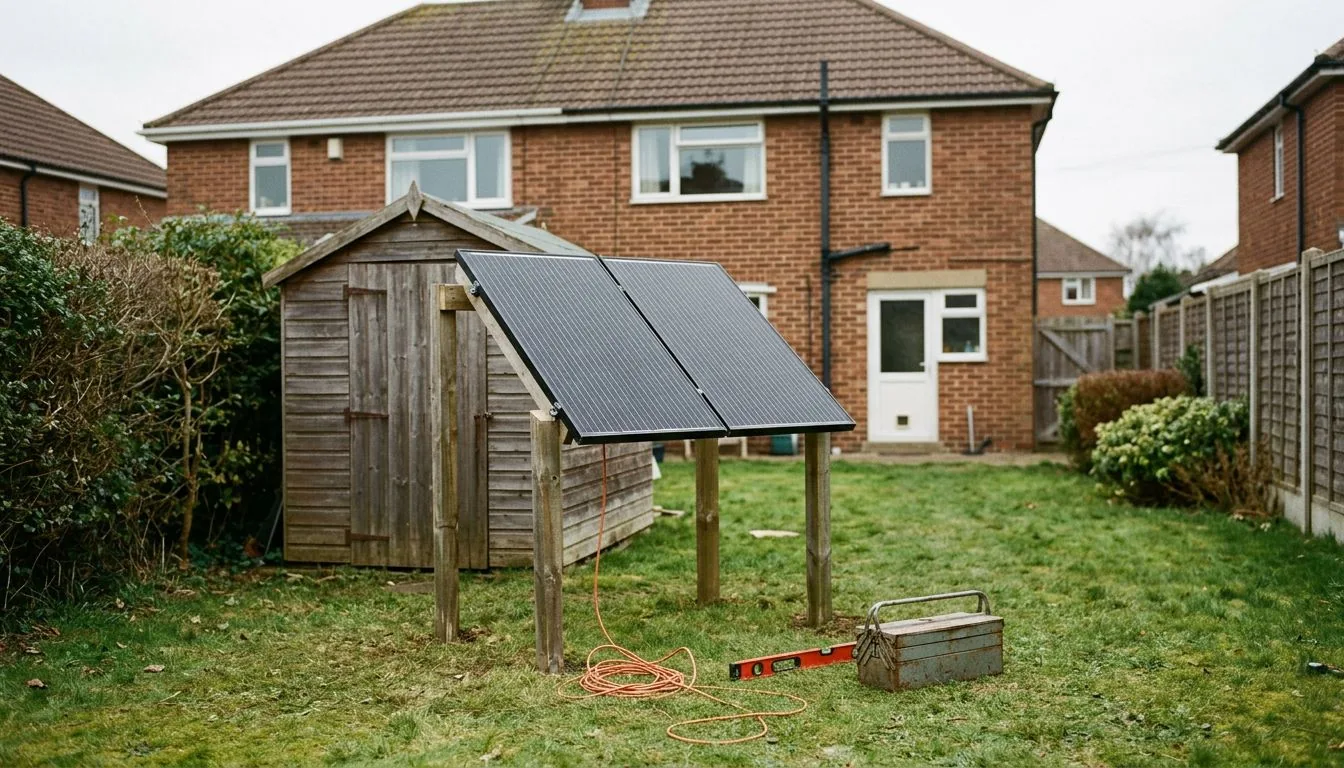
DIY solar panels in the UK sit in a narrow legal gap. You can now buy an approved plug-in kit and fit it yourself. However, you cannot wire a full roof system into your consumer unit without breaking the rules.
This guide sets out what you can legally do yourself, what you cannot, and why the line falls where it does. It covers England, Scotland and Wales, with a note on Northern Ireland.
Quick answer: what is legal?
Two routes exist. The first is a small plug-in kit. The second is a full fixed system, which is the kind most installers fit to a roof.
| Route | Can you do it yourself? | Main limit |
|---|---|---|
| Plug-in kit | Yes, if the kit is approved | 800 W maximum AC output |
| Fixed roof system | No, not the electrical work | Qualified electrician needed |
| Smart Export Guarantee payments | Not without an MCS installer | MCS certificate required |
In short, DIY solar is legal only at the small end. Everything bigger needs a professional.
Plug-in kits: the legal DIY route
Since 27 August 2026, plug-in solar kits can legally go into a normal socket in Great Britain. The rule came from SI 2026/848. A plug-in kit may have a maximum AC output of 800 W, and it must meet the government’s interim product specification.
The specification also caps the total panel power at 2,000 W. Above 960 W of panels, the maker must advise a professional check of your wiring. So a bigger set of panels does not remove the 800 W output limit.
There are strict conditions for using a kit:
- You must tell your network operator, using the G98 process (normally within 28 days).
- You can run only one kit per home under the current G98 rules.
- You must never use an extension lead or daisy-chain kits.
- The circuit needs RCD or RCBO protection.
Our guide to plug-in solar panels covers the kit rules in more detail. Meanwhile, our page on small plug-and-play systems compares what is on sale.
Sources: SI 2026/848 on legislation.gov.uk; DESNZ plug-in solar government response, July 2026.
How much does a kit actually give you?
A kit is much smaller than a roof system. A typical 4 kWp roof system has 9–10 panels. An 800 W output limit is a fifth of a 4 kW system’s rating, so a kit covers a slice of your daytime use rather than your whole bill.
For example, a typical UK home uses about 2,700 kWh of electricity a year (Ofgem’s medium figure). A small kit can trim that, but it will not replace it.
Fixed roof systems: why you need a professional
A fixed system is a different job. It connects to your consumer unit, it sits on your roof, and it feeds power back to the grid. Each of those steps carries a legal or safety rule.
The electrical work
In England, Part P of the Building Regulations covers electrical safety in homes. Connecting a solar array to your consumer unit is electrical work that must meet it. In practice, that means using an electrician or installer registered with a competent person scheme, who certifies the work, or notifying building control before you start.
Scotland, Wales and Northern Ireland have their own building rules. So check with your local building control before you start. The principle is the same everywhere: the wiring must be safe and signed off.
The roof
Building Regulations also normally apply to a roof installation. The Planning Portal notes that the roof must be able to carry the load, and some strengthening may be needed. As a result, a roof survey is not optional.
Working at height is the other risk. A fall from a roof or scaffold is a real danger, which is one more reason to leave roof work to a trained crew.
Smart Export Guarantee payments
Even if you could wire a system safely, you would lose the export income. The Smart Export Guarantee needs your installation and installer to be MCS-certified, or certified through an accredited equivalent such as Flexi-Orb. A DIY fit cannot meet that test.
Export rates vary. Open-market rates are about 3–6p a kWh, while rates tied to a supplier you also buy from reach about 12p. Our guide to what happens on installation day shows how a certified install runs from survey to sign-off.
Sources: Planning Portal: building regulations for solar panels; GOV.UK: Smart Export Guarantee; Approved Document P.
What you can do yourself
DIY does not have to mean nothing. Several useful jobs are yours to do, and they can cut the cost of a professional job.
- Gather your bills. A year of electricity data shows how much you use and when.
- Measure your roof. Note the pitch, the direction and any shading from trees or chimneys.
- Compare quotes. Ask at least three MCS-certified installers for itemised prices.
- Check the rules. Look up conservation areas, listed status and your lease.
- Keep panels clean and clear. Routine maintenance such as tidying overhanging branches is yours to do.
A typical 4 kWp system costs about £6,500–£8,500 fitted (October 2026), including 0% VAT. That VAT rate ends on 31 March 2027, when 5% returns. For a full-size system, the saving from DIY is therefore small next to the risk. For more on pro systems, see our overview of residential solar panels.
Planning rules for DIY installs
Planning rules apply to DIY work in the same way as to professional work. In England, rooftop solar is usually permitted development. Panels must not stick out more than 200 mm from a pitched roof, and they must not rise above the ridge.
However, plug-in solar is not permitted development on a wooden wall, balcony or timber cladding. Listed buildings also need consent. Our guide to the planning permission rules for solar sets out the details.
Scotland and Wales use their own rules, and England’s August 2026 changes do not apply there. For example, Scotland allows most rooftop panels to project up to 1 metre. See what solar generates in Scotland for local context.
Sources: SI 2026/896 on legislation.gov.uk; Scottish Government Planning Circular 1/2024.
Northern Ireland: check before you buy
The plug-in rules above come from regulations that do not extend to Northern Ireland. The legal position there is unclear, and there are open questions about how the rules fit with the Windsor Framework. So do not assume a kit is legal in Northern Ireland.
Instead, ask your network operator and your council before buying anything. Our page on solar panels in Northern Ireland explains the wider picture, including export payments.
Flats, rented homes and balconies
If you rent or live in a flat, you need permission first. The government says tenants and leaseholders should get consent from the landlord or freeholder before fitting a kit. Balconies bring extra planning limits, too. Read our guide to balcony solar for flats before you buy.
Cheaper routes than DIY
If cost is your worry, DIY is not the only option. Schemes and finance can cut the price without cutting corners. For example, the government’s Warm Homes Plan promises low- and zero-interest loans for solar, with most schemes opening from 2027. Our solar grants guide explains which schemes are available and who they are for.
Be careful with offers that sound too good. Read our guide on whether free solar panels are really free before you sign anything.
Frequently asked questions
Is it legal to install solar panels yourself in the UK?
It is legal to fit an approved plug-in kit of up to 800 W in Great Britain. However, a fixed roof system needs a qualified electrician for the wiring. You also lose Smart Export Guarantee income without an MCS-certified installer.
Do I need to tell anyone about a plug-in kit?
Yes. You must notify your network operator under the G98 process, normally within 28 days of switching on. Check your kit’s instructions, because the maker must supply them.
Can I get paid for the power I export from a DIY system?
Probably not. The Smart Export Guarantee requires an MCS-certified installation and installer. A plug-in kit will mainly save you money on the power you use yourself.
Can I fit a plug-in kit to a wooden balcony?
Not as permitted development in England. Plug-in solar is excluded on wooden walls and balconies and on timber cladding. Ask your council before you go ahead.
Can I buy a kit and wire it into my fuse box?
No. Wiring a generator into your consumer unit is electrical work that needs a qualified person. The plug-in route exists so that you do not have to.
Next step
If you want a full system, a certified installer can survey your roof and quote for the whole job. Request free quotes and we will connect you with installers in your area.