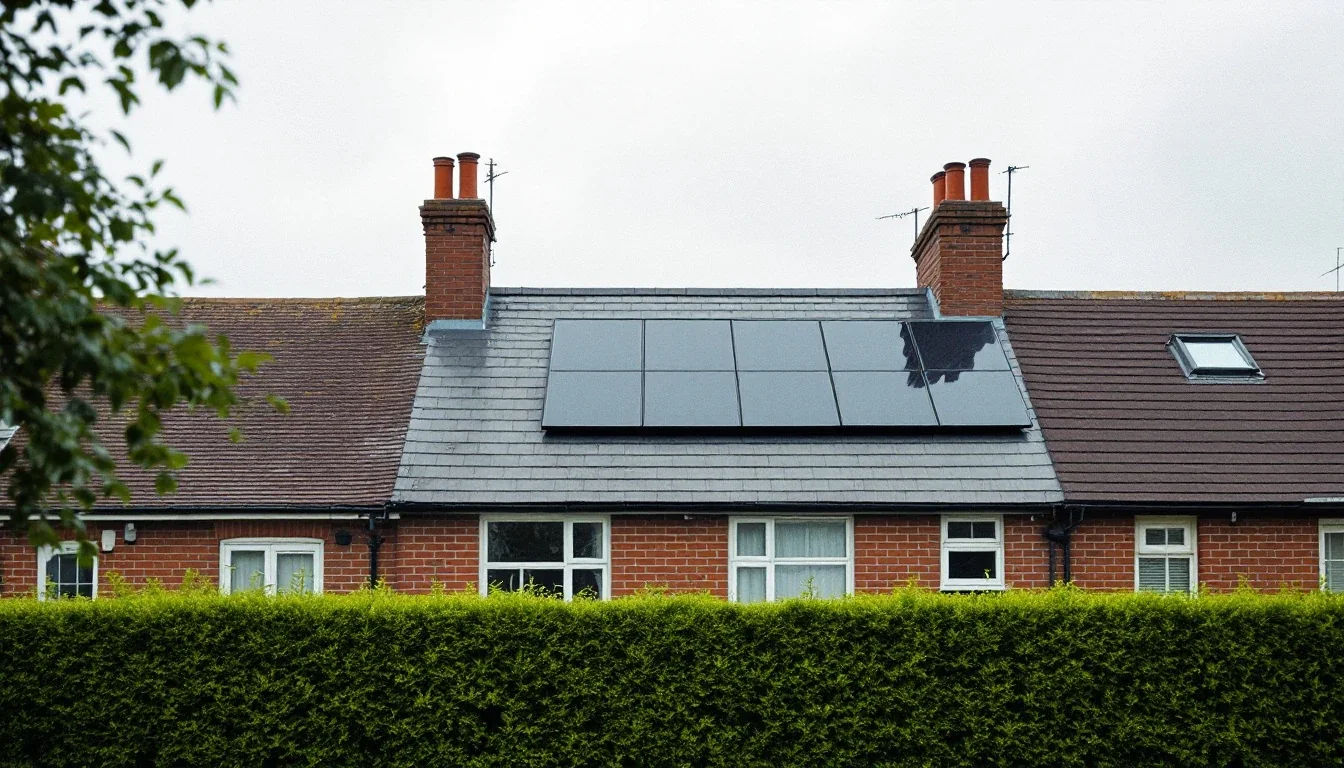
Free solar panels UK households can claim from the government are rare in 2026. A few schemes do exist, but they are aimed at lower-income homes and have strict rules, so most people will not qualify. This guide explains what is really on offer, and what to watch out for.
Rates and schemes below are correct as at October 2026. Schemes change often, so check the official pages before you act.
Are free solar panels really available in the UK?
For most homeowners, no. There is no national grant that pays for solar panels on any home. Instead, the government supports certain households through targeted schemes, and those schemes are closing or changing.
Where “free” offers do appear, there is usually a catch. Either you must meet an income test, or a company owns the panels, or you pay in another way. Therefore the sensible question is “what will this cost me over 25 years?”
Panels themselves are not cheap. For example, a typical 4 kWp system costs about £6,500–£8,500 fitted (October 2026). Solar panels fitted to homes are zero-rated for VAT until 31 March 2027. After that the rate goes to 5%.
For a fuller picture, see what fitting solar panels costs, because the true cost shapes every offer below.
Sources: DESNZ solar PV cost data and HMRC VAT guidance.
Government schemes that once offered free panels
Several well-known schemes no longer help new applicants. It is worth knowing this, because some websites still advertise them.
ECO4 is closing on 31 December 2026, and installers are finishing existing jobs. Solar was only ever available within ECO4 as part of a whole-house package for eligible low-income households. Don’t plan on it for a new project, and there will be no successor supplier obligation.
The Great British Insulation Scheme closed on 31 March 2026. Besides, it never funded solar panels.
The Boiler Upgrade Scheme is also not a solar grant, so do not confuse the two.
Sources: gov.uk response on ECO4 end date.
Real grants and support in 2026
Some help does exist, although it is limited. Our guide to solar panel grants available in the UK covers the detail, and the main points are below.
The government’s Warm Homes Plan, published in January 2026, promises low- and zero-interest loans for solar and batteries. It also promises fully funded installs for low-income households. Most of the schemes open from 2027, so check gov.uk before applying.
Separately, your council may run a Warm Homes: Local Grant for low-income households in England. Ask the council directly, because eligibility and funding vary by area.
Many people also ask about a “free solar panels UK government” scheme that applies to everyone. There isn’t one, so any advert claiming otherwise deserves suspicion.
Sources: gov.uk Warm Homes Plan.
Free solar panels in Scotland, Wales and Northern Ireland
Support differs sharply between nations. While each has its own rules, Wales is currently the most generous for lower-income households.
Scotland. Home Energy Scotland no longer funds standard solar panels or batteries. The only solar technology it still supports is hybrid PV-T panels, through an interest-free loan of up to £5,000. You need an MCS-certified installer and product. See our page on Scotland solar costs and support.
Wales. The Welsh Government’s Nest scheme can fit solar panels free for eligible lower-income households. Whether you qualify depends on benefits or income, and on your home’s EPC rating. Nest decides which measures to install, so solar is not guaranteed. Read more on Wales solar costs and support.
Northern Ireland. There is currently no general government grant for home solar panels in Northern Ireland. Check nidirect for any new scheme. However, our page on Northern Ireland solar costs and support explains the local picture.
Sources: Home Energy Scotland, Welsh Government Nest and Nest eligibility.
Rent-a-roof and other “no upfront cost” offers
Some companies offer to fit panels at no upfront cost. In return, they may keep the income from the electricity, or charge you a fee. Terms vary a great deal, so we cannot quote figures for these deals.
If you are offered one, read the contract closely. In particular, check these points:
- who owns the panels, and for how long;
- what happens if you sell the house or the company closes;
- whether you still get Smart Export Guarantee payments, or the company does;
- what the exit charges are.
Compare any such offer with a normal quote, because you can then see what you give up in return for paying nothing at the start.
Be cautious of cold calls and doorstep sales, since real schemes do not require you to act today. Always check the offer on a government page, and use an MCS-certified installer.
Why paying for panels can still be worth it
Even without a grant, solar can pay for itself. For instance, on our standard model, a 4 kWp system costing about £7,500 saves and earns roughly £590 a year at October 2026 prices. That means it pays for itself in about 13 years, or roughly 11–15 years depending on price, roof and export tariff.
Over 25 years the system returns roughly £13,800, about £6,300 more than it cost, at today’s prices. See how long solar takes to break even for the full workings.
Export income helps too. We assume 12p/kWh, a rate available if you import from the same supplier, while open-market rates are about 3–6p. Our guide to comparing SEG export tariffs shows how to choose.
You need an MCS-certified installation to receive these payments, because without an MCS certificate you can’t get paid under the Smart Export Guarantee.
Sources: gov.uk Smart Export Guarantee.
How to check if you qualify for help
Start with the official sources, not with an advert. Here is a sensible order, since each step rules schemes in or out.
- Check the nation-specific scheme: Home Energy Scotland, Nest in Wales, or nidirect in Northern Ireland.
- In England, ask your council about its Warm Homes: Local Grant, and watch gov.uk for Warm Homes Plan launches.
- Gather your benefit details and your EPC rating, since most schemes use them.
- If you do not qualify, get quotes from MCS-certified installers and compare them.
Weigh up the choice alongside the pros and cons of solar panels, although the right answer depends on your budget. If you decide to pay, our free quote form connects you with local MCS-certified installers, with no obligation.
Frequently asked questions
Can I get free solar panels from the UK government?
Generally no, because there is no scheme that gives every homeowner free panels. However, eligible lower-income households in Wales may get them through Nest, and England’s Warm Homes Plan promises support from 2027.
Is ECO4 still giving out free solar panels?
ECO4 closes on 31 December 2026, and installers are finishing existing jobs. Solar was only ever available within a whole-house package for eligible households. Don’t plan on it for a new project.
Are rent-a-roof schemes a good idea?
They can suit people who cannot afford the upfront cost, but terms vary widely. Therefore, check who owns the panels, who receives export payments and what happens if you move. Compare the deal with a normal quote.
Does the Warm Homes Plan give free solar panels?
It promises low- and zero-interest loans and help for low-income households, with most schemes opening from 2027. The detail is still emerging, so check gov.uk before applying.
Is there VAT on solar panels?
Solar panels fitted to homes are zero-rated for VAT until 31 March 2027. After that the rate goes to 5%. This zero rate saves roughly £300–£400 on a typical 4 kWp system compared with the old 5% rate.