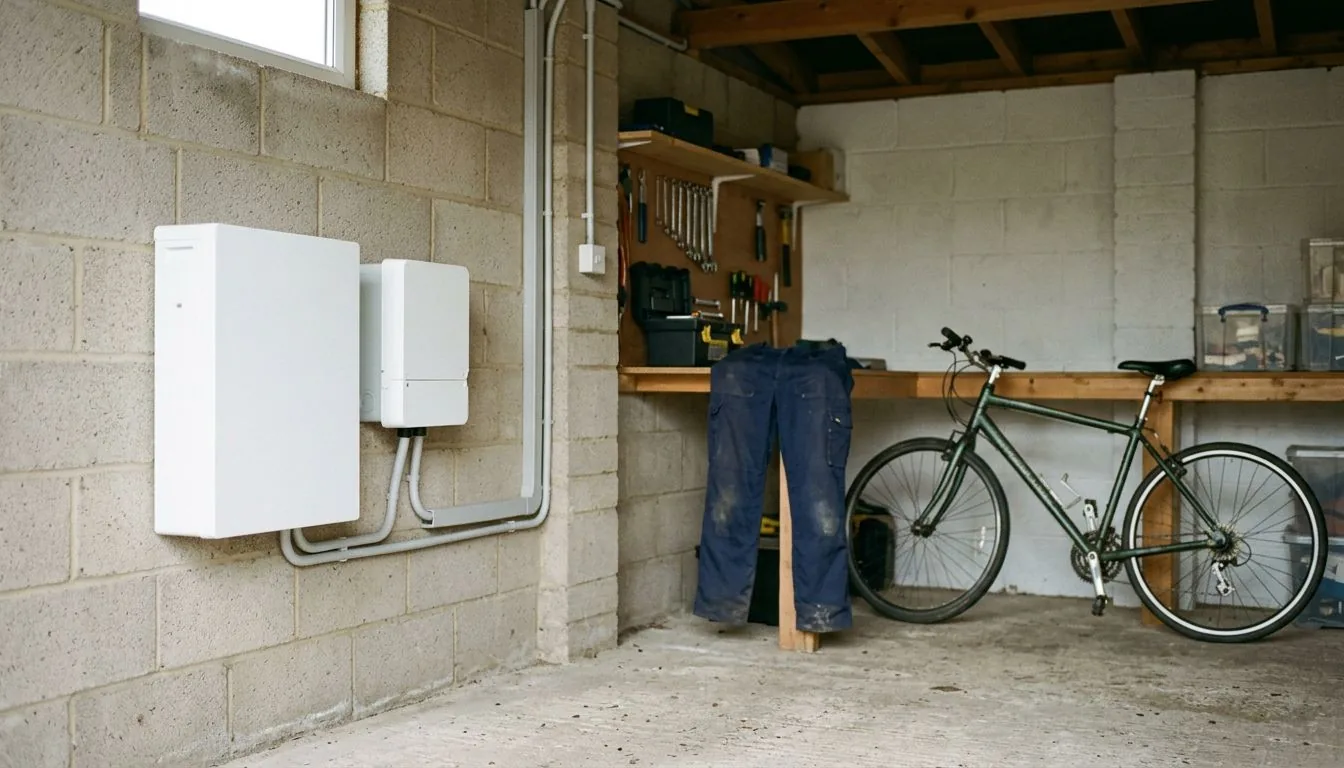
Solar battery storage in the UK lets you keep spare daytime power for the evening. Without a battery, anything you do not use as it is made goes to the grid. With one, you store it and use it later.
That sounds like an easy win. However, whether a battery pays for itself depends on your tariff and your habits. This guide gives the costs, the VAT position and a realistic payback.
How a solar battery works
First, panels make direct current (DC), and the inverter turns it into the alternating current (AC) your home uses. Next, your home uses what it needs. After that, any surplus either charges the battery or is exported.
Without a battery, your exports earn a payment under the Smart Export Guarantee (SEG). Suppliers set their own rates, so it pays to compare. Instead, a battery lets you use that power yourself, which is worth more when your import price is higher than the export rate.
There are two common set-ups. A DC-coupled battery connects through a hybrid inverter, so it suits new systems. By contrast, an AC-coupled battery has its own inverter, so it can be added to existing panels.
What a solar battery costs
When a battery is fitted with new panels, typical prices are:
| Battery size | Typical added cost (fitted with new panels) |
|---|---|
| 5 kWh | £2,500 to £4,000 |
| 10 kWh | £4,000 to £8,000 |
In other words, that is about £400 to £700 for each kWh of usable capacity (October 2026). However, a battery added later on its own usually costs more, because it needs a separate visit and often its own inverter.
For example, a 4 kWp system with a 5 kWh battery fitted together typically costs £10,000 to £14,000. By comparison, the same panels alone cost about £6,500 to £8,500. For a full picture, see what solar panels cost and save.
Sources: DESNZ solar PV cost data; GivEnergy UK datasheet, March 2026.
VAT on batteries
Since 1 February 2024, home batteries have been zero-rated for VAT. This covers batteries added to existing solar, batteries installed on their own that store grid power, and batteries fitted with new panels. The zero rate lasts until 31 March 2027.
After that date, the rate returns to 5%. For instance, on a £4,000 battery that is £200. If you are already planning a battery, the deadline is worth bearing in mind.
For a wider list of support, see solar panel grants available in the UK. Note that ECO4 closes on 31 December 2026, so do not plan on it.
Sources: HMRC guidance on batteries and VAT.
Is a battery worth it?
Here is our standard model. First, it assumes a 4 kWp system in the UK, a 12p export rate, and electricity at 26.32p per kWh (the Ofgem cap for October to December 2026). Second, it assumes that you use 30% of your solar power without a battery and 60% with one.
| Case | Cost | Yearly benefit | Payback |
|---|---|---|---|
| 4 kWp, no battery | about £7,500 | about £590 | about 13 years |
| 4 kWp plus 5 kWh battery | about £11,500 | about £740 | about 15 to 16 years |
So the battery adds about £150 a year, but it also adds about £4,000 to the price. On a flat-rate tariff, it lengthens the payback. Over 25 years, the panels alone return about £6,300 more than they cost, and the battery set-up returns about £6,000 more.
That is not the whole story. For one thing, the model leaves out cheap overnight tariffs, which can make a battery pay back faster. It also ignores future price changes. If you compare SEG export tariffs, a low open-market export rate of about 3p to 6p makes storing power look better. In that case, a battery is more attractive.
Finally, see the solar payback period for how we reach these numbers.
Who benefits most
A battery is more likely to suit you in these cases:
- You are out all day, so you use little power at midday.
- You have an electric car, so you need a lot of power at night. Read about pairing solar with an EV charger.
- You have a heat pump, which adds demand. See running a heat pump with solar.
- Your export rate is low, or you cannot get one.
In Northern Ireland, there is no Smart Export Guarantee. Power NI currently pays 11.88p per kWh for export (October 2026 to September 2027), but check with Power NI. See what solar generates in Northern Ireland for local detail. In every case, self-consumption matters most. The Manchester guide shows what solar generates in a northern city.
Choosing a battery
Many brands are on sale, including GivEnergy, FoxESS, Tesla, SolarEdge and Sungrow. We do not rank them here. Instead, read the datasheet for any battery you are offered, and compare how the leading home batteries compare in our review.
For example, GivEnergy’s 9.5 kWh battery carries a 12-year warranty with unlimited cycles, according to its March 2026 datasheet. Check the warranty, the usable capacity and the installer’s own guarantee for any model.
Next, size matters. For help, see how many panels you need. A typical home uses about 2,700 kWh a year, which is about 7 kWh a day. As a result, 5 kWh suits many homes, and 10 kWh suits larger households or those with an EV.
Frequently asked questions
Do batteries qualify for grants?
There is no general grant for home batteries. However, the Warm Homes Plan promises loans and help for low-income households, but most of it opens from 2027. Check gov.uk before you apply.
How long do solar batteries last?
It varies by model, so look at the warranty and the cycle limit on the datasheet. Never assume the figures from a different brand apply.
Can I add a battery to existing panels?
Yes, because an AC-coupled battery can usually be added to existing panels. A DC-coupled one needs a compatible hybrid inverter.
Is it better to fit solar and a battery together?
Usually, yes, because one visit means one set of scaffolding and one inverter. Fitting them together is also likely to cost less than adding a battery later.
Does a battery cut my standing charge?
No, because solar and batteries reduce the units you buy, but the standing charge stays the same. For the October to December 2026 cap, it is 54.83p a day.
Want a price for your own home? Get free quotes from MCS-certified installers.