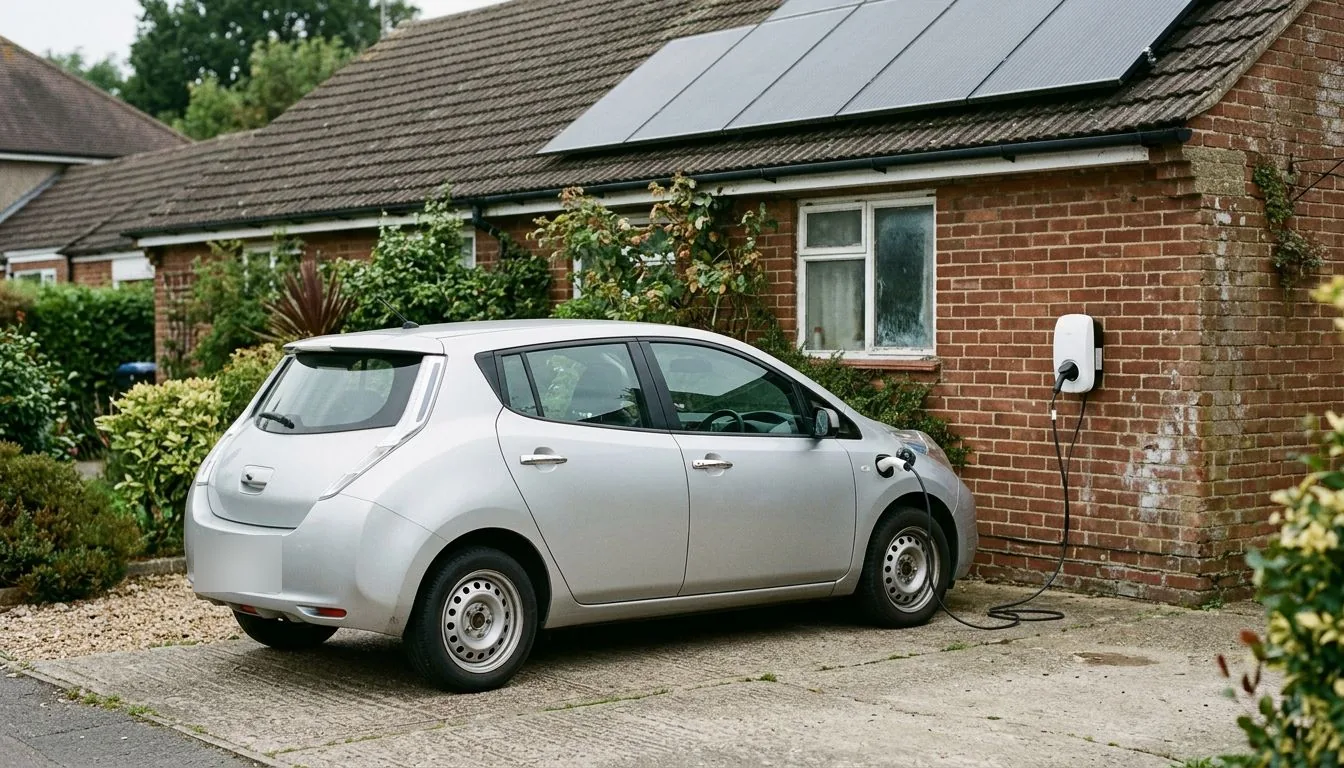
Solar panels and an EV charger work well together. Your panels make cheap electricity by day, while your car can use a lot of it. This guide explains how solar charging works, what each kWh is worth and how to size your system for an electric car.
Prices and rates are as at October 2026. The sums use our standard model, because that lets you swap in your own figures.
How do solar panels charge an EV?
Solar panels feed your home first. However, whatever your home does not use goes to the grid, or into a battery if you have one. A solar-diverting charger sits in between and sends the surplus to your car instead.
A basic charger takes power from the grid at a fixed rate. A diverting charger watches how much your panels make and how much the house is using. As a result, it adjusts the car’s charging speed to match the surplus.
Many diverting chargers offer more than one mode. One mode charges from surplus only, and another tops up from the grid so the car still gets a minimum charge. Check the modes before you buy, because they differ between products.
What is a kWh from solar worth?
The value comes from what you would otherwise pay or earn, since each kWh has two possible uses.
- Under the Ofgem price cap for October to December 2026, electricity costs an average of 26.32p per kWh.
- Our standard export rate is 12p per kWh. That is a rate you get if you import from the same supplier. Open-market rates are about 3–6p.
Therefore, a kWh that charges your car saves you 26.32p. The same kWh exported would earn 12p, or about 4p on a low open-market rate. In other words, diverting is worth about 14p more per kWh than exporting at 12p.
For example, here is an illustrative sum. If solar supplies 1,800 kWh of charging a year, that saves about £474 against grid power. It also earns you about £258 more than exporting the same energy at 12p. Your own saving depends on how much you charge in daylight.
Sources: Ofgem price cap, October to December 2026; GOV.UK Smart Export Guarantee guidance.
How much of your charging can solar cover?
Less than many people hope. Panels make most of their power in the middle of the day, in summer. However, many drivers charge at night, and December output is roughly a quarter to a third of June’s.
Solar covers a bigger share if you are home by day. Working from home, shift work and weekend charging all help. If you leave early and return late, solar covers much less, because the car is away or not plugged in.
A 4 kWp system on a typical roof makes about 14 kWh a day on average in May to July. Our guide to monthly UK solar output data shows each month, although yours will vary. How far that goes depends on your car. Check its miles per kWh in the handbook. At an illustrative 3.5 miles per kWh, 14 kWh adds about 49 miles, if all of it went to the car.
How many extra panels do you need for an EV?
Start with the kWh of charging you want solar to supply, then divide by 900, since that is our standard yield. That is our standard yield for a typical UK roof, in kWh per kWp a year.
For example, 1,800 kWh ÷ 900 = 2 kWp. At about 440 W a panel, that is four or five extra panels.
To get a starting number, take your yearly miles and divide by the car’s miles per kWh. Then decide what share you will charge by day. Add the result to your home’s yearly use. Our calculator guide shows the full method for the combined total.
Location matters as well, since yield differs by city. A 4 kWp system makes about 3,870 kWh a year in Birmingham and about 3,540 in Manchester, using PVGIS figures for an ideal roof. See solar panels in Birmingham and solar panels in Manchester for local detail. To size a whole system around a car, start with solar panel systems for homes.
Roof space may limit you, however. If it does, consider putting panels in the garden instead of the roof. Our guide to how many panels a typical home needs helps with the count for extra panels too.
Add a battery or a cheap night tariff
A battery stores midday surplus and releases it later. It can top up the car in the evening, although a small battery empties quickly. A car uses far more energy in one charge than most home batteries hold. See solar battery storage costs and benefits and the best solar batteries compared.
While it helps, on a flat-rate tariff a 5 kWh battery lengthens payback to about 15–16 years in our model. That model leaves out cheap overnight EV tariffs, which can change the sums. If you drive mostly in the evening, a cheap overnight tariff may beat a battery for car charging.
Rates for these tariffs change often, so they date quickly. Check your supplier’s current rates before you decide.
Does an EV improve the case for solar?
Yes, because you use more of your own power. Our standard model assumes you use about 30% of your solar yourself without a battery. A car that charges in daylight can push that share up, and each kWh used at home is worth more than one exported.
On our standard model, a 4 kWp system costing about £7,500 saves and earns roughly £590 a year. It pays for itself in about 13 years, or roughly 11–15 years. An EV lets you do better than that if you charge by day. For the full picture, read an honest look at whether solar pays off.
If you also plan a heat pump, read solar panels for a heat pump. Both loads compete for the same winter-light shortfall.
For prices and returns, see what solar panels cost and save. When you are ready, ask for free quotes and tell installers about your car.
Practical tips
- Tell your installer about your EV before the quote, so they size the system and the charger together.
- Ask whether the charger works with your inverter and any battery.
- Charge on bright days and at weekends if you work away.
- Check current rules and funding for chargers on GOV.UK, because they change.
Frequently Asked Questions
Q: Can I charge my EV entirely from solar panels? A: Not in a typical UK year. In summer, you can charge from surplus on bright days. In winter, output is much lower, so you will need grid power. Most owners get a share of their charging from solar, not all of it.
Q: Does charging my car reduce my export income? A: Yes. Power that goes to the car is not exported, so you earn nothing on it. However, a kWh that charges the car saves 26.32p, whereas the same kWh exported earns about 12p at best.
Q: Do I need a special charger? A: A solar-diverting charger is the way to charge from your surplus automatically. A basic charger works too, but it does not follow your solar output. Ask your installer which models work with your system.
Q: Is there a grant for a home charger? A: Funding for chargers has changed over time and depends on your home. Check GOV.UK for current rules. Do not assume you qualify.
Q: Should I fit panels and a charger at the same time? A: It can save a second visit, and the installer can plan the wiring once. It also lets you size the panels for the car’s demand. Compare quotes for both together and separately.