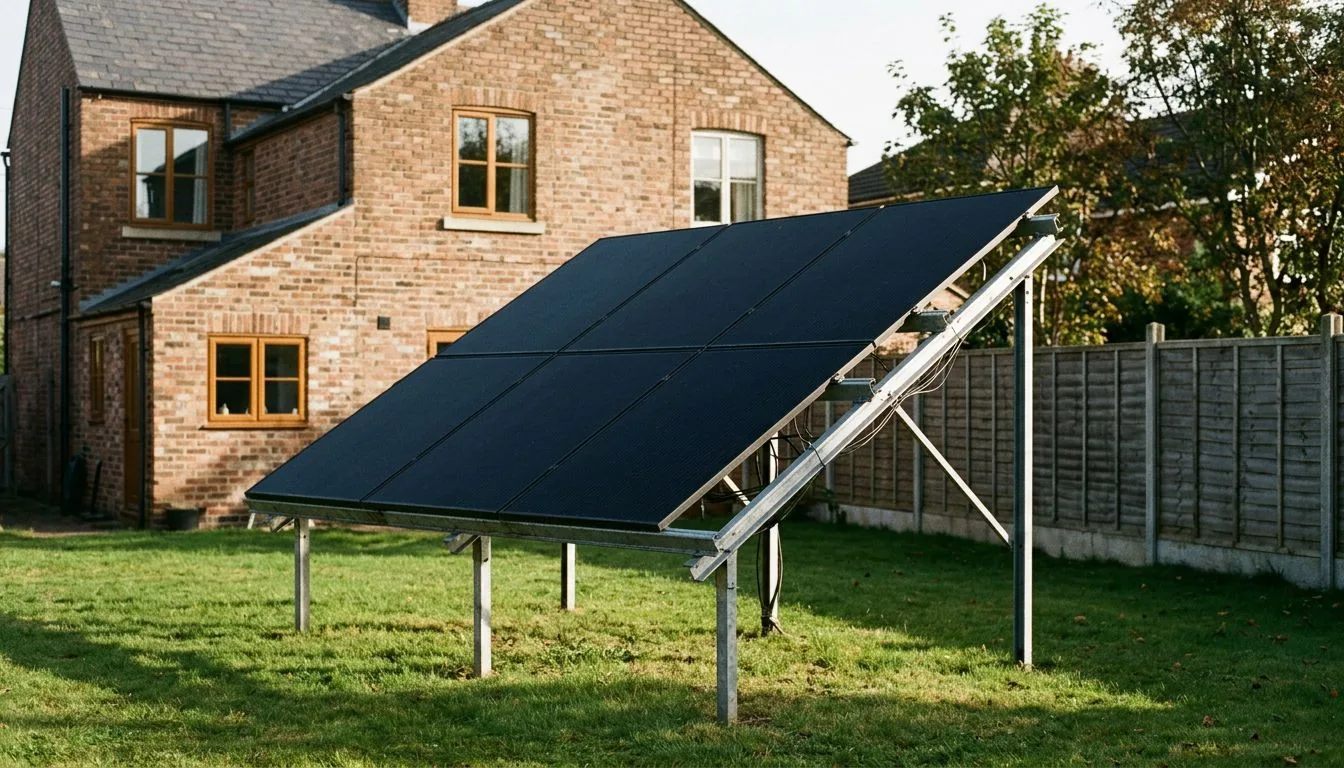
Ground mounted solar panels in the UK suit homes where the roof is shaded, north-facing or simply too small. Instead of using the roof, you put the panels on a frame in the garden or a paddock. As a result, you choose the angle and direction yourself.
This guide explains the planning rules, which changed in England on 27 August 2026. It also covers costs, cable runs and the cases where a ground array is worth the extra work.
When a ground array makes sense
A ground array is worth considering in several situations:
- Your roof faces north or is badly shaded.
- The roof is old and close to needing replacement.
- You have a garden, paddock or field with open, unshaded space.
- You want a bigger system than the roof can hold.
- The house is listed, so roof panels would be difficult.
It is less suitable for a small urban garden or a shaded plot. In addition, it needs a clear run for the cable back to the house.
On rural plots, ground arrays are common, because there is plenty of room. In a built-up area, a roof is usually simpler.
Planning rules in England
Ground mounted panels count as a “stand-alone” installation. Under the rules that took effect on 27 August 2026, a stand-alone array at a house can be permitted development, so you would not need to apply for planning permission, if it meets these limits:
- The panels total no more than 9 m² in surface area.
- The array is no higher than 4 m in most of the garden.
- It is no higher than 2 m if it is within 5 m of the boundary.
- It is no higher than 1 m if it is within 5 m of the boundary and in front of the main elevation of the house.
- It is not in the grounds of a listed building or on a scheduled monument.
Conservation areas and World Heritage Sites have extra limits, and some need prior approval. If your home is in either, ask your council first.
Nine square metres is small. For example, a typical panel is about 1.76 m by 1.13 m, so the limit holds about four panels, or roughly 1.8 kWp. For anything bigger, you will usually need planning permission. Read our wider guide to planning permission rules for solar for more.
However, one caution applies. We read the 2026 order closely, but the official Planning Portal guidance was not available to check. Confirm the rules with your council before you order.
Sources: Town and Country Planning (General Permitted Development) (England) (Amendment) Order 2026.
Rules in Wales, Scotland and Northern Ireland
England’s change does not apply elsewhere. For instance, Wales still follows its own rules. A stand-alone array there must be the only one on the property. It can be 4 m high, or 2 m within 5 m of the boundary. It must also sit at least 5 m from a highway, have no side longer than 3 m, and cover no more than 9 m².
Similarly, Northern Ireland also allows one stand-alone array, up to 4 m high. The order includes the same duty to site panels so they have as little effect on appearance as possible.
Scotland has separate householder rules, and they differ from England’s. Ask your council whether a garden array needs consent.
In every nation, a listed building needs separate permission. Check before you ask for quotes.
Sources: Welsh Government guidance on solar panels; Planning (General Permitted Development) Order (Northern Ireland) 2015, as amended.
What ground mounted solar costs
A typical 4 kWp roof system costs about £6,500 to £8,500 fitted (October 2026), including 0% VAT. However, a ground array costs more than that, because of the extra work.
The extra comes from several items:
- Foundations or ground screws.
- A steel mounting frame.
- A trench and cable from the array to the house.
- Fencing, where needed.
We do not quote a fixed premium, since no reliable figure exists for UK homes. Instead, ask for an itemised quote that splits the groundwork, the frame and the cable. For the base price, see a full breakdown of installation prices.
Zero-rated VAT on solar ends on 31 March 2027, after which the rate becomes 5%.
Sources: DESNZ solar PV cost data; HMRC VAT guidance.
Tilt, direction and output
The main benefit of a ground array is freedom. By comparison, a roof’s angle and direction are fixed, but a frame can face due south at about 35°. In the EU’s PVGIS model, that setup is close to the best you can get in the UK.
A north-facing roof makes only about half as much as that ideal. In contrast, a ground array can recover most of the difference. Our guide to the best angle and direction for panels has the numbers.
Some frames also carry two-sided panels, which catch light reflected from the ground below. Read about mono, poly and thin-film panels before you pick a type.
Cable runs and sizing
The cable run from the array to the inverter adds cost, and the length matters. A longer run needs thicker cable and a deeper trench. Therefore, measure the distance early. Ask your installer to price it separately.
Besides this, you need to size the system to your use. For help, see sizing a system to your usage. A ground array is often a good way to fit more panels than the roof allows.
Meanwhile, compare it with a flat roof. Our guide to flat roof mounting options shows when that route is cheaper. For an overview of the whole system, read about residential solar panels.
Frequently asked questions
Can I put a ground mounted array in a field?
Possibly, but because a field is not part of your home’s garden, so permitted development rights for houses usually do not apply. Talk to your planning authority before you spend money. A pre-application enquiry can save time.
How many panels fit in 9 m²?
About four panels of a typical size. In total, that is roughly 1.8 kWp, which suits a small system or a top-up to an existing one.
Do ground arrays need more maintenance?
The panels need the same care as roof panels, but access is easier. Even so, you must keep grass and weeds from shading them. Check the frame each year for rust and movement.
Are ground panels a theft risk?
Theft is uncommon, but you should take sensible steps. For example, ask your installer about tamper-resistant fixings and about security marking. Check your home insurance too.
Can I get a grant for a ground array?
Grants for home solar are limited, and most schemes are closing or only open to low-income households. Our guide to solar panel grants available in the UK lists what exists. Ask for free quotes to compare prices.