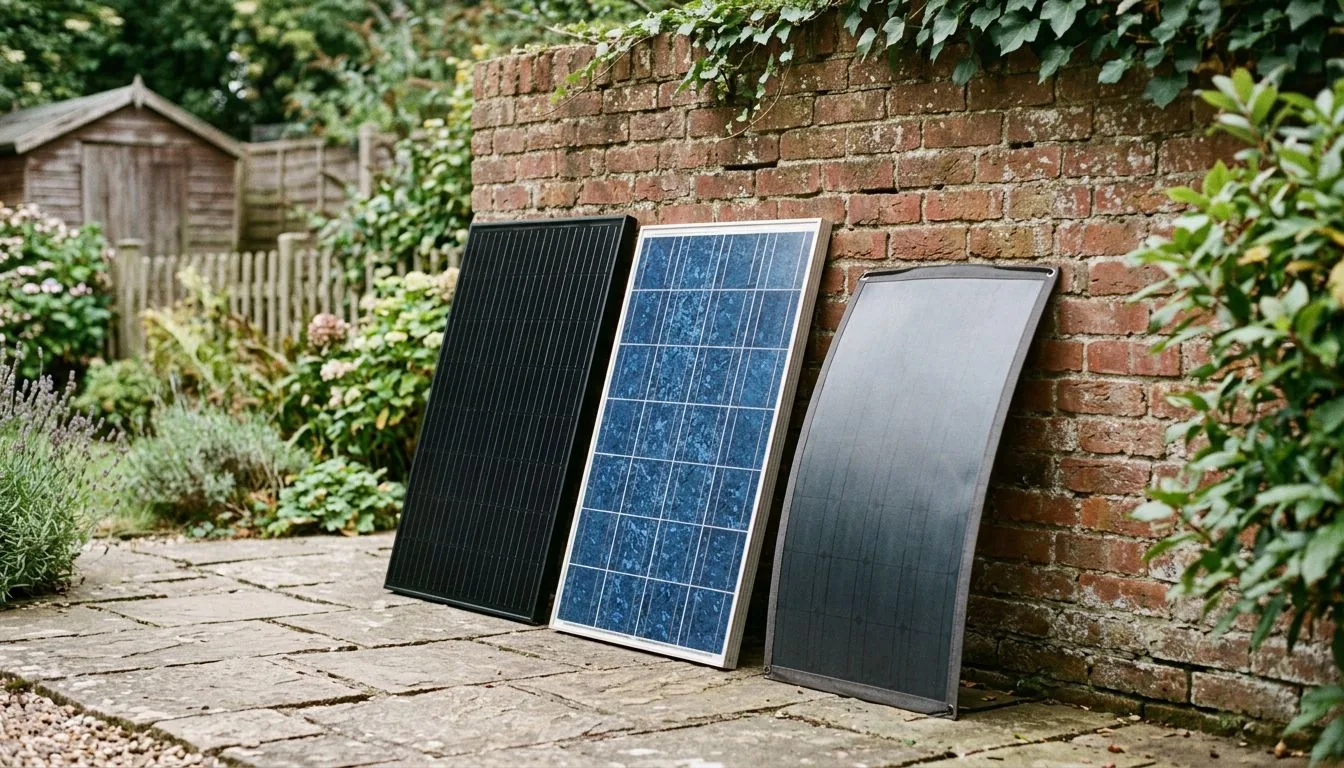
There are three main types of solar panels: monocrystalline, polycrystalline and thin-film. Each uses a different cell. The type affects efficiency, roof space and price. This guide helps you read an installer’s quote with confidence.
The main types of solar panels
Monocrystalline panels
Mono panels use cells cut from a single silicon crystal. The uniform crystal lets electricity flow easily. As a result, they are the most efficient common type.
They look dark and even. Almost all panels fitted to UK homes now are mono. Most convert about 20% to 23% of sunlight to electricity.
Polycrystalline panels
Poly panels use cells made from many silicon fragments melted together. They look speckled blue. The process is cheaper, but the cells are less efficient.
Mono has largely replaced poly on UK homes. If an installer quotes poly panels today, ask why. You will need more roof area for the same power.
Thin-film panels
Thin-film panels spread a very thin layer of material over glass, metal or plastic. They can be flexible. However, they are less efficient, so they need more space.
You see them on large commercial roofs and curved surfaces. For a typical house, they are rarely the best choice. Integrated options are covered in our guide to integrated solar roof tiles.
Sources: JA Solar JAM54D41-450/LB datasheet.
Cell technology: PERC, TOPCon and HJT
These names describe how a mono cell is built. They are not separate panel types.
- PERC adds a rear layer that reflects spare light back into the cell.
- TOPCon improves that rear layer to cut energy losses.
- HJT layers thin silicon on the crystal to raise output further.
Higher-end cells usually cost more. However, the gain only matters if your roof is small. Check the efficiency on the datasheet rather than the label.
For the numbers behind this, see the most efficient panels. To compare brands, see leading solar panel brands and warranties.
Which type suits the UK?
Mono panels suit the UK for two reasons. They make more power from a small roof, and they work well in diffuse light. Since most UK roofs are limited, space is often the deciding factor. On a London terrace, for example, solar panels in London explains why higher-efficiency panels can help. Output also varies by region, and the PVGIS figures on what solar generates in Scotland show a lower annual yield there.
A typical home panel today is about 1.76 m by 1.13 m. It weighs about 22 kg and is rated at around 430 to 450 W. A 4 kWp system needs 9 to 10 panels and about 18 to 20 m² of roof.
For the sizes in detail, read solar panel sizes and dimensions. To see how a domestic solar system fits together, start with our main guide.
Sources: JA Solar datasheet.
Cost and value by panel type
A typical 4 kWp system costs about £6,500 to £8,500 fitted (October 2026), with 0% VAT until 31 March 2027. Most of that price is the whole job, not the panel type. Mounting, inverter and labour all count.
Therefore, a cheaper panel does not always give a cheaper system. If you need more panels to fill the same output, the saving can disappear. See solar panel installation costs for a full breakdown, or what solar panels cost and save for returns.
You can match the size to your needs too. Our guide on sizing a system to your usage shows how many panels you need.
Sources: DESNZ solar PV cost data.
Lifespan and warranty
Panels typically last 25 to 30 years or more. Good modern panels lose roughly half a percent of output each year. After 25 years they still make around 85% to 90% of their original output.
Expect a product warranty of at least 12 years. A performance guarantee of 25 to 30 years is normal. Check the datasheet, because terms differ by maker.
You may also notice small kits sold for balconies. See plug-in balcony solar kits and plug-and-play solar kits. These use the same panel types but follow separate rules.
Frequently asked questions
Do all-black panels make more electricity?
No. The black finish is about looks. Output depends on the cells, so compare the watt rating.
Are mono panels worth the extra cost?
For most homes, yes. They give more power per square metre. That matters on small roofs.
Can I mix panel types on one system?
It is possible with the right equipment, but it is rarely wise. Matched panels make warranty claims simpler.
Should I buy the most efficient panel?
Only if roof space is tight. On a large roof, a standard mono panel is usually better value.
Ready to see what suits your roof? Get free quotes from MCS-certified installers.