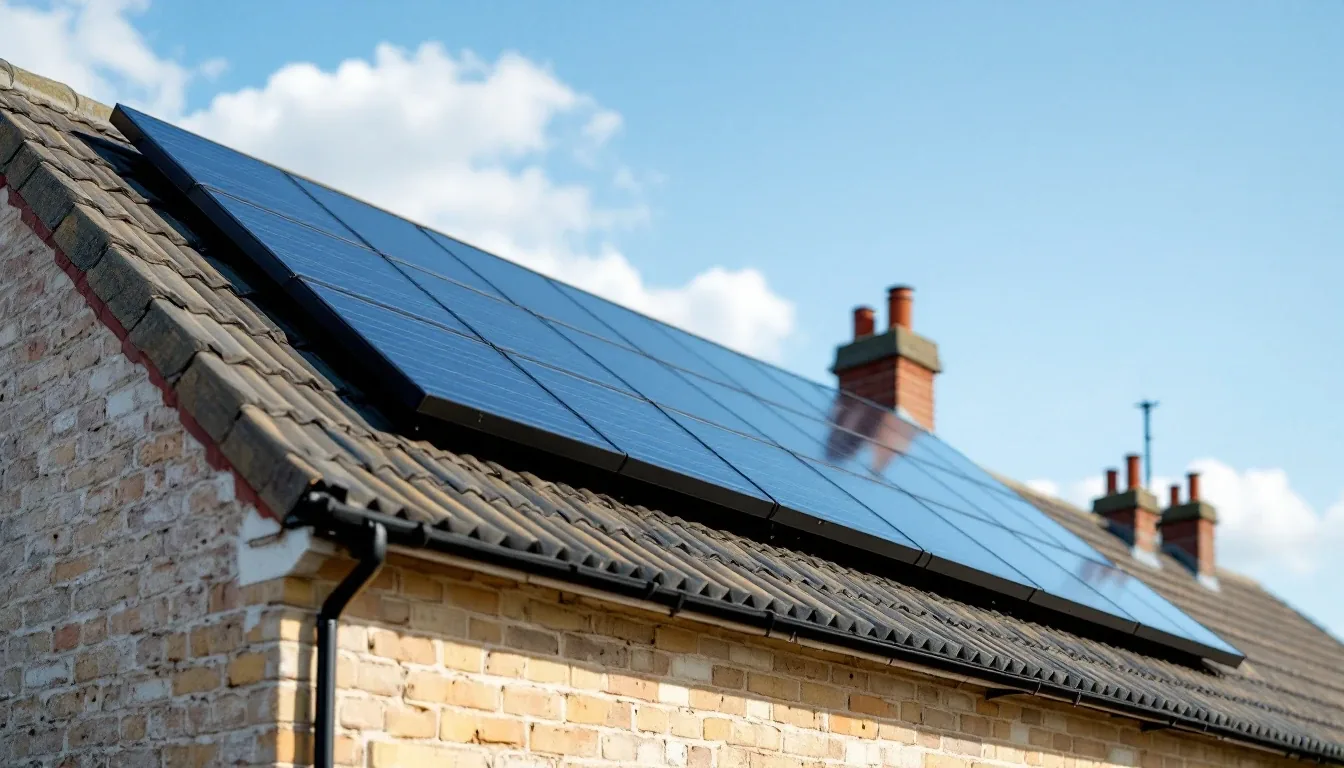
Solar panel sizes in the UK are more standard than most people expect. Almost every home panel sold today follows one common format. Because of that, you can check whether your roof has room before you ask for a quote.
Standard solar panel sizes in the UK
A typical home panel today measures about 1.76 m by 1.13 m. It weighs about 22 kg and is rated at around 430–450 W. Most makers build it from 54 full cells, or 108 half-cells, in a frame about 30 mm deep. Since the format is so common, quotes are easy to compare.
One widely sold example is the JA Solar JAM54D41-450/LB. Its datasheet lists 1,762 × 1,134 × 30 mm, 22 kg and 450 W. Other makers differ by a few millimetres, so always read the datasheet for the exact model on your quote.
That makes each panel roughly 2 m². In other words, you can picture one panel as a large door laid on your roof.
Sources: JA Solar JAM54D41-450/LB datasheet, as listed by UK retailers.
How many panels fit on a roof
Your system size sets the panel count. Each panel makes about 430–450 W, so you divide your target kWp by that figure. The table below uses the same rule for four common sizes.
| System size | Panels | Roof area | Typical annual output | Typical cost fitted |
|---|---|---|---|---|
| 3 kWp | 7 | about 14 m² | about 2,700 kWh | £5,500–£7,000 |
| 4 kWp | 9–10 | about 18–20 m² | about 3,600 kWh | £6,500–£8,500 |
| 5 kWp | 11–12 | about 22–24 m² | about 4,500 kWh | £7,500–£9,500 |
| 6 kWp | 13–14 | about 26–28 m² | about 5,400 kWh | £9,000–£11,000 |
Costs are the house ranges as at October 2026 for a system without a battery, with 0% VAT until 31 March 2027. Output uses 900 kWh per kWp a year, a cautious figure for a typical UK roof.
For comparison, a typical UK home uses about 2,700 kWh of electricity a year (Ofgem’s medium figure). Therefore even a 3 kWp system can match that on paper, although you will not use all of it as it is made. Our guide to how many panels a typical home needs explains how to pick a size.
Sources: DESNZ solar PV cost data, Ofgem typical consumption values.
Work out your usable roof space
Your roof area is not the same as your usable area, because panels need a gap from the edges and ridge, and chimneys, roof windows and vents all take space. Shade from a neighbour’s tree or a dormer can rule out a section too.
Here is a quick way to check:
- Measure the width and height of the sunniest roof slope.
- Take off about a third for edges, gaps and obstacles.
- Divide what remains by 2 m² to count the panels.
For example, a slope of 6 m by 4 m is 24 m². After losing a third, about 16 m² remains, which fits about 8 panels. That is a system of about 3.5 kWp.
Panels can sit in portrait or landscape. While both work, an installer will test both layouts on a drawing, and you should ask to see it. Our guide to what happens on installation day shows how the layout is fixed on site.
How to read a panel datasheet
Every panel comes with a datasheet, and the size details sit near the top. Look for four lines: the dimensions, the weight, the power rating and the cell count. Together they tell you how much roof you need and how heavy the array will be.
The datasheet also lists the product and performance warranties. Because two panels of the same size can differ a lot in quality, compare those lines too. Ask your installer for the sheet for the exact model on the quote, not a generic one.
Small roofs, terraces and flats
Terraced houses often have narrow slopes, so a 2 or 3 kWp system may be all that fits. That still works, since panels make power per watt of rating, not per roof. A smaller system costs less, and you use more of what it makes. For what different system sizes cost and save, see our costs and savings guide.
City roofs bring their own limits. See solar panels in London for typical roof types and yields, and what solar generates in Leeds for stone terraces and a northern roof.
If you have no roof of your own, other options exist. Read solar options for flats and rented homes for balcony kits and shared roofs.
Weight and roof strength
Each panel weighs about 22 kg. Ten panels weigh about 220 kg, so over a 20 m² area the load is about 11 kg per square metre before rails and fixings. Most sound roofs cope with this, yet your installer must still check the structure.
Ask the surveyor to look at the rafters and the tiles. However, if the roof needs repair, do it before the panels go on, because lifting them off later costs more.
Larger and smaller panels
Panels for commercial roofs and ground arrays are usually bigger and more powerful. They are awkward to lift and place, so they suit those jobs better than houses. Older home panels were smaller and made less power each.
Bigger panels do not always mean better value. What matters is watts per square metre, which depends on cell quality. Our guide to what panel efficiency figures mean explains that measure.
Brand datasheets also differ on warranty length, so compare leading solar panel brands and warranties alongside size. Panels are one part of a domestic solar system, alongside the inverter and any battery.
Planning limits on size
Size is not only about space. In England, since 27 August 2026, rooftop solar on a house is usually permitted development. Panels must stick out no more than 200 mm from a pitched roof, and no higher than the highest part of the roof.
On a flat roof, the array can rise up to 600 mm above the highest part of the roof. A ground-mounted array can be permitted development if the panels total no more than 9 m². Check with your council if your home is listed or in a conservation area.
Roof space matters more if you plan a heat pump. A heat pump in a typical home uses roughly 3,500 kWh of electricity a year, more than the 2,700 kWh the rest of the house uses. See running a heat pump with solar before you decide how big to go.
Sources: SI 2026/896 on legislation.gov.uk.
Frequently asked questions
What size is a standard solar panel in the UK?
A standard home panel is about 1.76 m by 1.13 m and 30 mm deep. It weighs about 22 kg. Check the datasheet, as each maker differs slightly.
How many solar panels fit on a typical house roof?
It depends on the roof. As a guide, 8–14 panels make a 3.5–6 kWp system, and larger roofs fit more. Terraced roofs often fit fewer.
How much roof space does a 4 kWp system need?
A 4 kWp system needs 9–10 panels and about 18–20 m² of roof. You also need clear space around the array for edges and obstacles.
Can I fit more small panels instead of fewer large ones?
Yes, but the roof area and the total watts matter more than the panel count. Smaller panels with lower power need more roof for the same output.
Do solar panels need to face south?
South is best, but east and west roofs make roughly 80% as much. Size your system to the roof you have, then ask your installer to model the output.