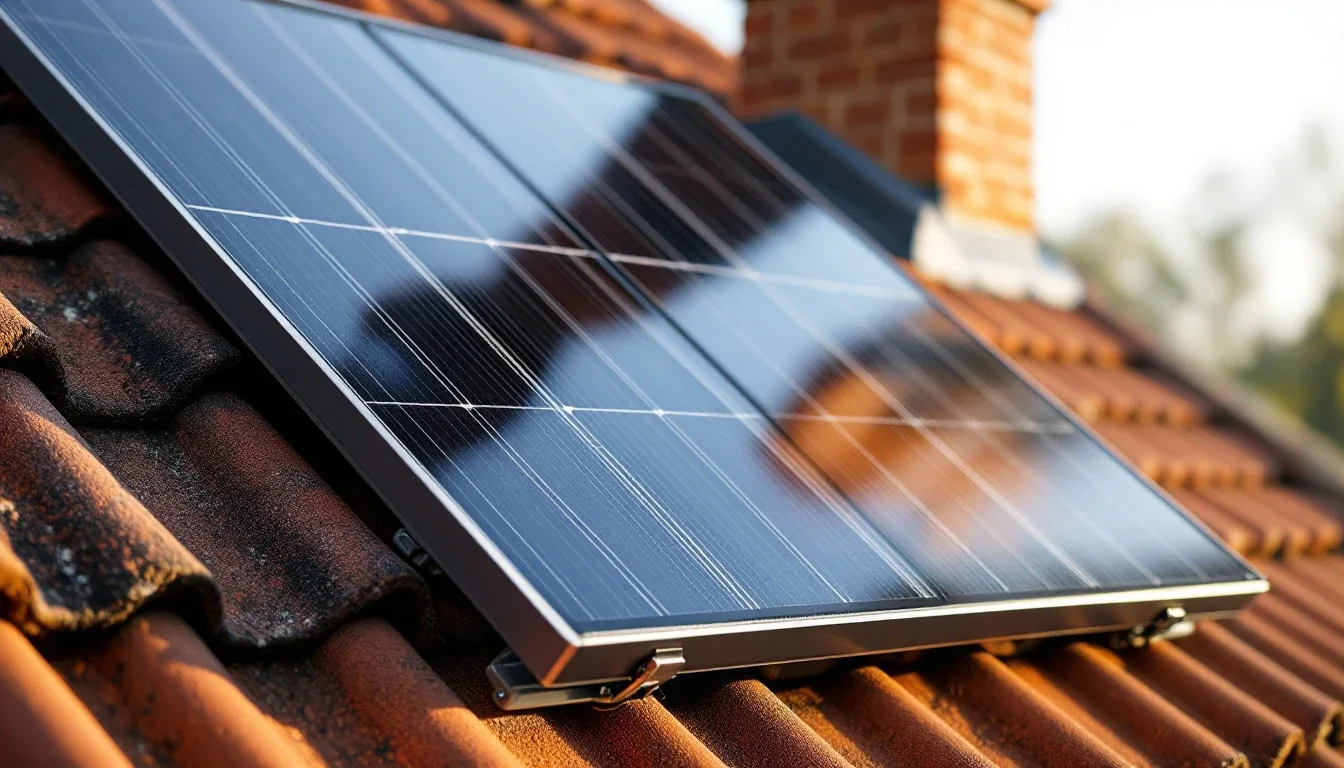
Solar panel efficiency is the share of sunlight that a panel turns into electricity. In the UK, most home panels sit between 20% and 23%. This guide explains what that number means, when it matters and when it does not.
What solar panel efficiency means
Efficiency compares a panel’s power rating with its area. Makers test panels under standard conditions of 1,000 watts of sunlight per square metre. The formula is power divided by area times 1,000.
Take a typical modern panel. It measures about 1.76 m by 1.13 m, which is almost exactly 2 m², and it is rated at 450 W. So 450 divided by 2,000 gives about 22.5%. That matches the datasheet of one widely sold model, the JA Solar JAM54D41-450/LB.
Most panels sold for UK homes today convert about 20–23% of sunlight to electricity. The other 77–80% leaves as heat or bounces off. That is normal, and it is not a flaw.
Sources: JA Solar JAM54D41-450/LB datasheet, as listed by UK retailers.
Why efficiency matters for your roof
Higher efficiency means more watts from the same space. Take a 4 kWp system. At 20% efficiency you need about 20 m² of roof, while at 23% about 17.5 m² will do.
That gap matters on a small roof, a terrace or a roof with a dormer. If you have plenty of room, however, a cheaper panel at 20–21% can give the same system size for less money. Our guide to solar panel sizes and dimensions shows how many panels fit.
Efficiency does not change the price of electricity, and it does not change how long the panels last. Therefore judge it alongside cost per watt, warranty and the roof you have.
Most efficient solar panels UK buyers can choose
The best panels sold for homes advertise efficiencies in the low to mid 20s. Figures of about 23–24% appear on some datasheets, usually for premium models with back-contact cell designs. Aiko is one maker in this class: its Neostar 2P datasheet lists up to 24.3%.
Treat any claim with care. Always read the datasheet for the exact model, because ranges differ by model and the figure may change when a maker updates a product. Name-brand claims in adverts are not a substitute for the sheet.
These panels also cost more. Whether the extra price pays off depends on your roof, since the gain is extra watts per square metre. If space is tight, a premium panel can let you fit a bigger system. If space is plentiful, it rarely does. Our costs and savings guide puts the price of a system beside what it earns.
For a side-by-side view of makers and warranties, read our guide to comparing panel manufacturers.
Panel types and cell technology
Monocrystalline panels dominate the mainstream residential market today. They cut cells from a single crystal of silicon, which gives the 20–23% range above. Older polycrystalline and thin-film panels usually convert less, so they need more roof for the same output.
Newer cell designs squeeze out more power by wasting less light. Half-cut cells, for example, reduce electrical losses, and back-contact designs move the wiring away from the sunny side. These improvements are why modern panels make more power than older ones of a similar size.
For a full breakdown, see mono, poly and thin-film panels.
What efficiency does not tell you
Efficiency is measured under standard test conditions. Real roofs differ, because the sun moves, clouds pass and panels warm up. A hot panel makes slightly less power than a cool one, so a breezy roof helps.
Orientation matters far more than a point or two of efficiency. Using the EU’s PVGIS model for London, here is what happens to output as direction changes:
| Direction and tilt | Output vs south at 35° |
|---|---|
| South, 35° | 100% |
| South-east, 35° | 95% |
| South-west, 35° | 93% |
| East or west, 35° | 78–80% |
| Flat | 83% |
| North, 35° | 53% |
Those gaps are far bigger than the difference between a 21% and a 22% panel. Our guide to how orientation affects output explains how to read your own roof. In the UK the best angle is about 35–40°, facing due south. Anywhere from 20° to 45° costs you no more than about 4%.
Sources: PVGIS tool (EU JRC).
Efficiency, light and where you live
People often ask whether efficient panels do better in dull UK weather. The honest answer is that location sets your output, not efficiency. Using PVGIS, 1 kWp of south-facing panels at 35° makes about 1,025 kWh a year in London and about 885 in Manchester.
That gap comes from the amount of sunlight each place gets. It is a region effect, so a higher efficiency panel would lift both figures by the same proportion. See what solar generates in Manchester for diffuse-light detail, and what solar generates in Scotland for northern yields.
Panels do keep working in cloud, but they make less. Month by month, December output is roughly a quarter to a third of June’s.
Efficiency over time
Every panel loses some output with age. Good modern panels lose roughly half a percent of output a year, so after 25 years they still make around 85–90% of their original output. Panels typically last 25–30 years or more.
So a 22% panel is about 19–20% after 25 years. Because the loss is slow, a datasheet’s performance warranty matters more than a headline efficiency. Expect a product warranty of at least 12 years and a 25–30-year performance guarantee.
What efficiency means for real output
Rated power, not efficiency, drives your yearly generation. For a typical UK roof we assume about 900 kWh per kWp a year. A 4 kWp system therefore makes about 3,600 kWh, whichever efficiency the panels have.
Efficiency only changes how much roof that 4 kWp needs. See how much a system generates month by month for real data, and our overview of residential solar panels for the whole system.
Sources: PVGIS tool (EU JRC).
How to choose
Start with your roof, since it sets the limit. Then ask each installer for the model, its efficiency, its watts, and its product and performance warranties. Compare the price per kWp, not the price per panel.
Choose a high-efficiency panel when space is the constraint. Choose a mainstream 20–22% panel when it is not. Either way, insist on an MCS-certified installer, so you can claim export payments.
Frequently asked questions
What is a good efficiency for a solar panel?
For UK homes, 20–23% is a good range. Mainstream monocrystalline panels sit in it. Check the datasheet for the exact model.
What are the most efficient solar panels in the UK?
Premium back-contact panels, such as Aiko’s, advertise the highest figures, up to about 24%. Read each current datasheet, because models change. A higher figure matters most on small roofs.
Does a more efficient panel produce more electricity?
Only per square metre. A 450 W panel makes the same power whether it is small or large. A more efficient panel simply fits that power into less space.
Do solar panels work better in cold weather?
Cool panels run a little better than hot ones, but winter has less sunlight overall. As a result, output is far lower between November and March.
Is it worth paying more for higher efficiency?
It is worth it when roof space is tight and you want a bigger system. It is rarely worth it on a large roof, where a cheaper panel can reach the same size.