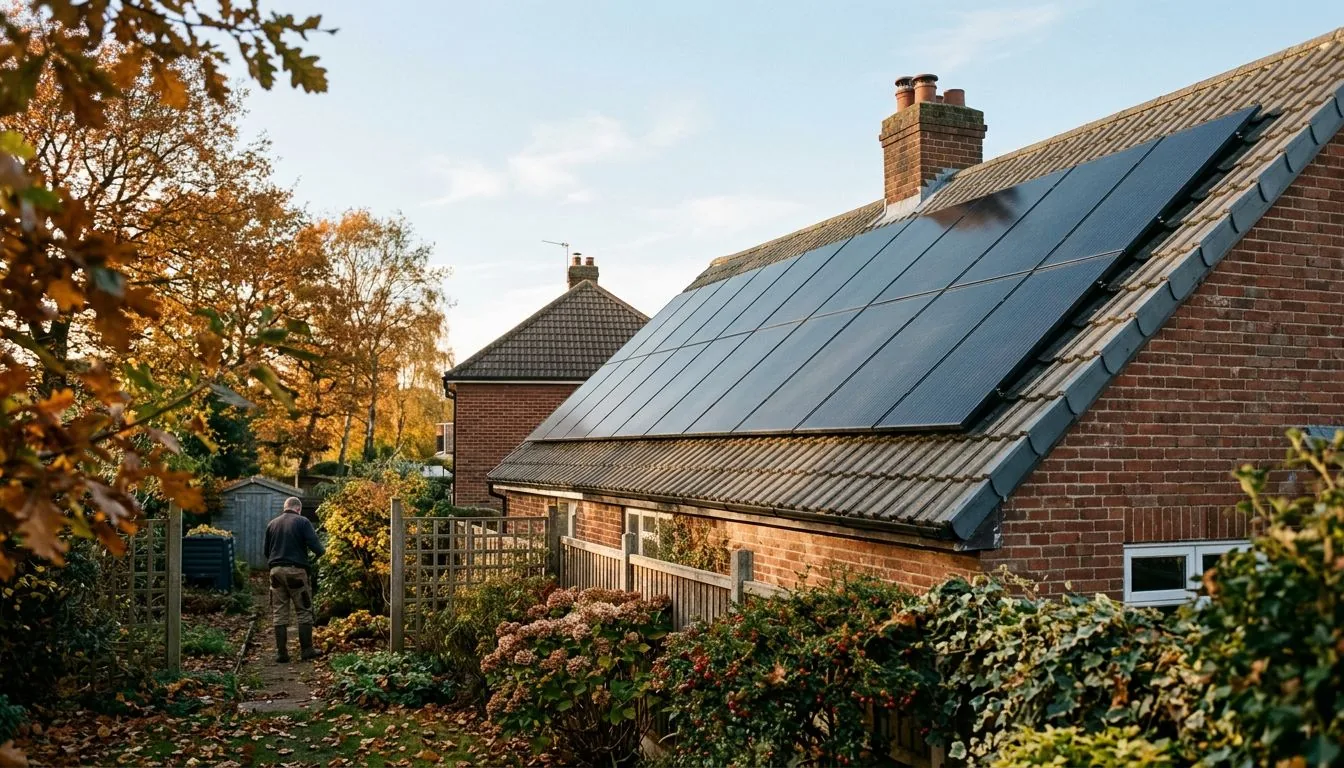
The best angle for solar panels in the UK is about 35–40°, facing due south. However, most roofs are not perfect, and they still work well. The real question is how much you lose when your roof points another way.
This guide answers that with real numbers. It uses the EU’s PVGIS solar model for London, so every percentage comes from the same method.
Quick answer: the best tilt and direction
Face south and tilt the panels at 35–40°. That setup makes the most electricity over a year. Anywhere from 20° to 45° loses no more than about 4%, so a roof pitch in that band is fine.
Direction matters more than angle. East- and west-facing panels make roughly 80% as much as a south-facing array. North-facing roofs make only about half as much. So do not rule out a roof just because it is not perfect.
How much does each angle and direction give?
The table shows 1 kWp of panels in London, using PVGIS v5.2 with 14% system losses. It compares each option with south-facing panels at 35°, which makes 1,025 kWh a year.
| Orientation and tilt | kWh per kWp a year | % of south at 35° |
|---|---|---|
| South, 35° | 1,025 | 100% |
| South, 45° | 1,025 | 100% |
| South, 20° | 983 | 96% |
| South-east, 35° | 973 | 95% |
| South-west, 35° | 955 | 93% |
| East, 20° | 845 | 82% |
| East, 35° | 822 | 80% |
| East, 45° | 794 | 77% |
| West, 20° | 827 | 81% |
| West, 35° | 796 | 78% |
| Flat (0°) | 852 | 83% |
| North, 35° | 547 | 53% |
The PVGIS optimum for London is 40°, pointing five degrees east of south. It makes 1,029 kWh, which is 100.4% of the base case. In other words, the true best angle beats 35° by less than half a percent.
Sources: PVGIS v5.2, EU Joint Research Centre, SARAH2 radiation database, retrieved 4 October 2026.
Why the angle matters less than you think
The curve is flat near the top. A tilt of 30° makes about 99% of the best figure, and 50° also makes about 99%. So a few degrees either way is almost irrelevant.
Steeper angles fall away more quickly. A south-facing panel at 60° still makes about 96% of the 35° figure. At 75° it makes about 87%, and a fully vertical panel makes about 73%.
Summer versus winter
Angle changes when your panels produce, not only how much. A steep panel suits low winter sun. A shallow panel suits high summer sun.
For example, in London a south-facing panel at 60° makes about 45 kWh per kWp in December. At 35° it makes about 37 kWh, and at 20° only about 29 kWh. In June the order flips: 20° makes about 127 kWh and 60° about 103 kWh.
So a steeper tilt gives up a little summer output for more winter output. Because winter is when you use most power, that can be a fair trade. However, the annual total still favours 35–40°. Our guide to monthly UK solar output data shows how generation changes through the year.
East, west and east-west roofs
An east- or west-facing roof loses about a fifth of its output. However, the shape of the day changes. East-facing panels generate more in the morning. West-facing panels generate more in the evening.
Many UK homes use most power at those times. So the output you lose may be partly offset by the share you use directly.
Some installers split an array between two roofs. A system with half the panels on each side makes about 79% of a south-facing system at 35° in London. That is based on the average of the east and west figures above.
What that means in kWh
Take a 4 kWp system in London. Facing south at 35°, it makes about 4,100 kWh a year. South-west makes about 3,820 kWh, and east makes about 3,290 kWh. A north-facing roof makes about 2,190 kWh.
As a result, you should compare a poor roof with the price of extra panels. A larger east-west array can make up for the lost output, if the roof has room.
Flat roofs and ground mounts
Panels laid flat make about 83% of the best figure. However, flat roofs normally use tilted frames, because flat panels collect dirt and standing water. Read our guide to solar on a flat roof for the options and the 600 mm planning limit in England.
A ground mount gives you full choice of angle and direction. If your garden has space and sun, consider putting panels in the garden instead. Planning limits apply to height and size.
What about different parts of the UK?
The same orientation percentages apply broadly across the country, but the totals differ. For south-facing panels at 35° with PVGIS, Bristol makes about 1,020 kWh per kWp, Leeds about 945 kWh, and Glasgow about 850 kWh.
So a perfect roof in Glasgow makes less than a poor roof in the south of England. Our pages on solar panels in Bristol and on Scotland solar costs and support show local figures. To see what a system saves once you know your likely output, read what solar panels cost and save.
Other things that cost you output
Angle is only one loss. Shade from a chimney, tree or neighbour’s roof can cut output sharply, and panels in the shade can drag down a whole string. Dirt, heat and inverter losses also add up. Our guide to what panel efficiency figures mean explains the main ones.
For that reason, a proper roof survey is vital. Our guide to how an installation works step by step shows when the survey happens and what it checks.
Can you change the angle yourself?
You usually cannot change a roof’s pitch, because panels sit parallel to the roof. Tilt frames exist for flat roofs and the ground. They also appear in plug-in kits for balconies and gardens.
Tilt frames bring wind loading and fixing issues, so use approved kit and follow the maker’s instructions. For the legal side, see what you can legally install yourself.
Frequently asked questions
What is the best angle for solar panels in the UK?
About 35–40° facing due south. The EU’s PVGIS model gives London an optimum of 40°, pointing five degrees east of south. Anything between 20° and 45° loses no more than about 4%.
Do east-facing solar panels work well?
Yes. East-facing panels at 35° make about 80% of a south-facing array in London. They produce more in the morning, which suits households that are busy early in the day.
Are north-facing solar panels worth it?
Rarely. North-facing panels at 35° make only about 53% of the best figure. A larger array on another roof slope usually makes more sense.
Is a flat roof bad for solar panels?
No, but it is not ideal. Panels laid flat make about 83% of a south-facing tilt. Tilted frames lift output and help rain wash off dirt.
Does the angle matter more in winter?
It does. A 60° tilt makes about 21% more than 35° in December in London, but less in summer. Over the full year, 35–40° still wins.
Next step
Not sure how your roof measures up? A certified installer can check pitch, direction and shading on the day of the survey. See how a domestic solar system fits together or request free quotes to compare options for your home.