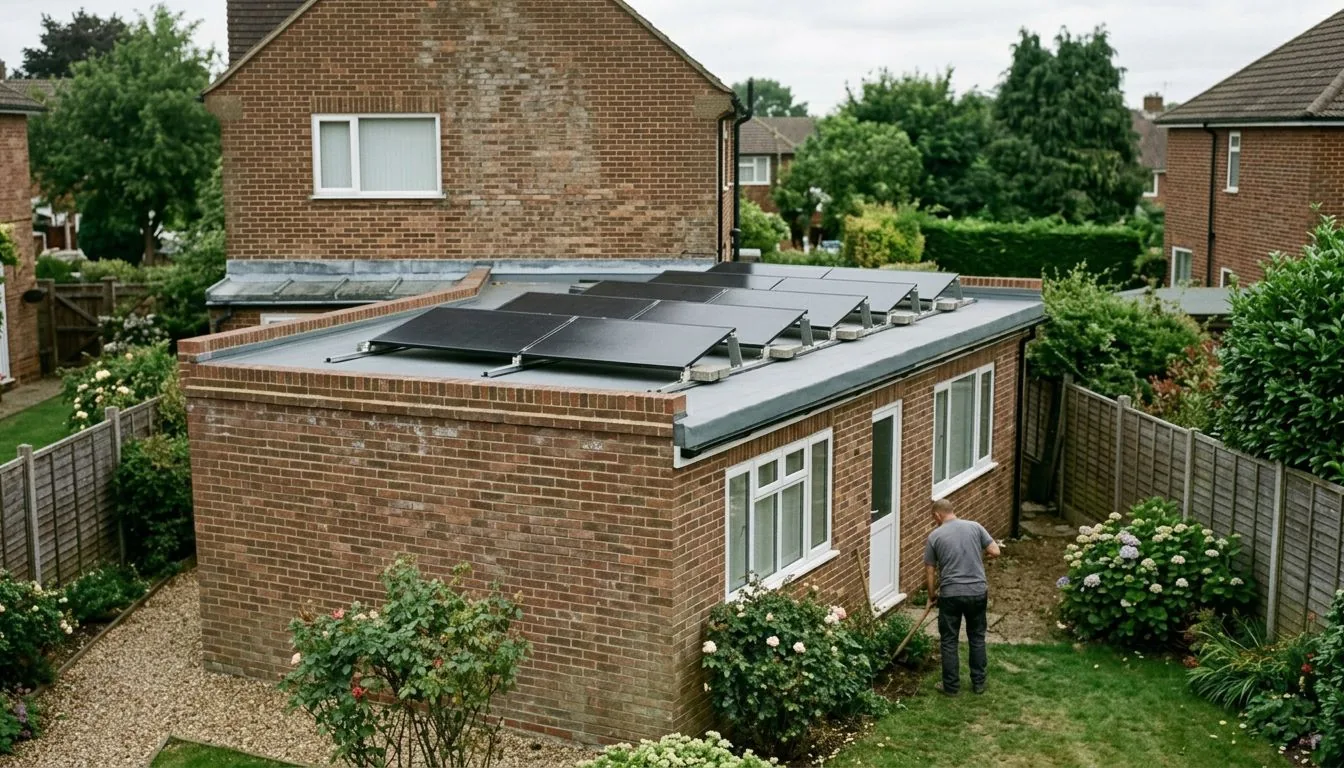
Flat roof solar panels in the UK are a very good fit for extensions, garages and many modern homes. A flat roof has no natural tilt, so installers add frames to angle the panels towards the sun. In return, you get easy access and full control over the direction the panels face.
This guide covers the planning rules, the mounting options and the costs. It also explains how much output you give up compared with a pitched roof.
Planning rules for solar on a flat roof
The rules changed in England on 27 August 2026. Rooftop solar on a house is now usually permitted development, which means you do not need to apply for planning permission. On a flat roof, the highest part of the panels must be no more than 600 mm above the highest part of the roof, not counting chimneys.
Older guides say 200 mm. That figure now applies only to pitched roofs, where panels must not stick out more than 200 mm from the roof slope. If you see 200 mm quoted for a flat roof in England, the guide is out of date.
The rules are different in the rest of the UK. Wales still uses its own rules, which ask for panels to sit at least 1 m from the roof edge and no more than 1 m above the roof. Scotland uses a “1 metre” allowance, and Northern Ireland has its own order. Check with your council before you commit.
Listed buildings always need consent, and so can homes in conservation areas or under an Article 4 direction. For the full picture, see our guide to when solar needs planning consent.
Sources: Town and Country Planning (General Permitted Development) (England) (Amendment) Order 2026; Welsh Government guidance on roof and wall-mounted solar panels.
How solar on a flat roof works
Most UK flat roofs are covered in EPDM rubber, felt, bitumen or GRP. Because of this, the main design choice is how to fix the frames without causing leaks. The panels themselves are the same ones used on any other roof, as described in our guide to the main types of solar panel.
Frames hold the panels at a tilt, usually lower than the ideal angle. A lower tilt also means the panels shade the row behind them less, so the rows sit closer together. Meanwhile, you can face the whole array due south, whichever way the building points.
Ballast or fixed mounts
There are three common ways to hold a frame on a flat roof. Each has trade-offs.
| System | How it works | Main benefit | Main drawback |
|---|---|---|---|
| Ballast | Weights such as concrete blocks hold the frame down | No holes in the waterproof layer | Adds weight to the roof |
| Fixed | Brackets are bolted through the roof and sealed | Strong in high winds | Every hole must be made watertight |
| Hybrid | A mix of weights and a few fixings | Balances weight and security | More design work |
Ballast systems are popular because they leave the roof covering intact. However, the extra weight matters. Ask your installer for a roof loading check, and for a structural engineer’s report if the roof is old or lightly built.
Wind is the other big factor. A good installer will calculate the uplift for your site and choose the ballast or fixings to suit. Before you sign, check how the system will affect your roof warranty, and ask the roofing manufacturer or your roofer if you are unsure.
What flat roof solar costs
A typical 4 kWp home system costs about £6,500 to £8,500 fitted (October 2026), including 0% VAT. Government figures based on MCS installs put the average home retrofit at roughly £1,650 to £2,100 per kW. Our guide to solar panel installation costs shows the full range by system size.
A flat roof can add to that price. Frames, ballast, extra fixings and a structural check all cost money, and some roofs also need scaffolding. We do not quote a fixed extra here, because the amount depends on your roof. Ask for an itemised quote that shows the mounting separately.
Zero-rated VAT on solar ends on 31 March 2027, when the rate rises to 5%. If you are comparing quotes, what solar panels cost and save explains how the numbers fit together.
Sources: DESNZ solar PV cost data; HMRC VAT guidance on energy-saving materials.
Output compared with a pitched roof
Panels laid completely flat produce about 83% of what the best south-facing 35° array makes. Tilted frames close most of that gap. In London, a 20° tilt facing south gives about 96% of the best case, according to the EU’s PVGIS model.
In other words, a low-tilt flat roof array gives up only a few percent. For tips on this, read how orientation affects output. It also helps that the array can face south even when your house does not.
Some flat roofs use an east-west layout instead. Two rows of panels face opposite ways, which spreads generation across the morning and the evening. Because the rows can sit closer together, you can fit more panels on the roof. The peak at midday is lower, though.
Pitched sections, alternatives and the garden
Some homes have both a flat extension and a pitched main roof. In that case, an installer may suggest panels on both. If the pitched part is awkward, integrated solar roof tiles are another option, although they usually cost more.
If the roof is too small or too shaded, consider putting panels in the garden instead. For a wider look at how a system fits together, see how a domestic solar system fits together.
Flat extensions are common in big cities. If you live there, what solar generates in London and what solar generates in Birmingham show typical yields.
Maintenance and safety
Low-tilt panels shed less rain, so they collect dirt more easily than steep ones. A gentle clean now and then keeps output up. Always keep safe, though, and never walk on a roof you have not checked.
Flat roofs are easier and cheaper to reach than steep ones. Even so, leave the installation itself to a professional. You need an MCS-certified installer to be paid under the Smart Export Guarantee, and working at height is risky.
Frequently asked questions
Do I need planning permission for solar on a flat roof?
In England, usually not. Since 27 August 2026, panels are permitted development if the highest part is no more than 600 mm above the roof. Listed buildings, and some homes in conservation areas, need consent, so check with your council.
Does ballast damage a flat roof?
A well-designed ballast system does not pierce the roof covering. However, it adds weight, so the roof must be able to carry it. Ask for a loading check before you agree to the work.
How far apart should the rows be?
The spacing depends on the tilt and where you live. Steeper panels cast longer shadows, so they need more room. Your installer will use shading software to set the gap.
Is east-west better than south on a flat roof?
It depends on how you use power. South-facing panels make the most in total. An east-west layout spreads output through the day and fits more panels, which can suit a household that is busy in the morning and evening.
Can I fit panels on a flat roof myself?
We do not recommend it. Roof work is dangerous, and without an MCS-certified installation you cannot get SEG payments. Use a certified installer instead.
Ready to compare prices? Get free quotes from installers who work on flat roofs.