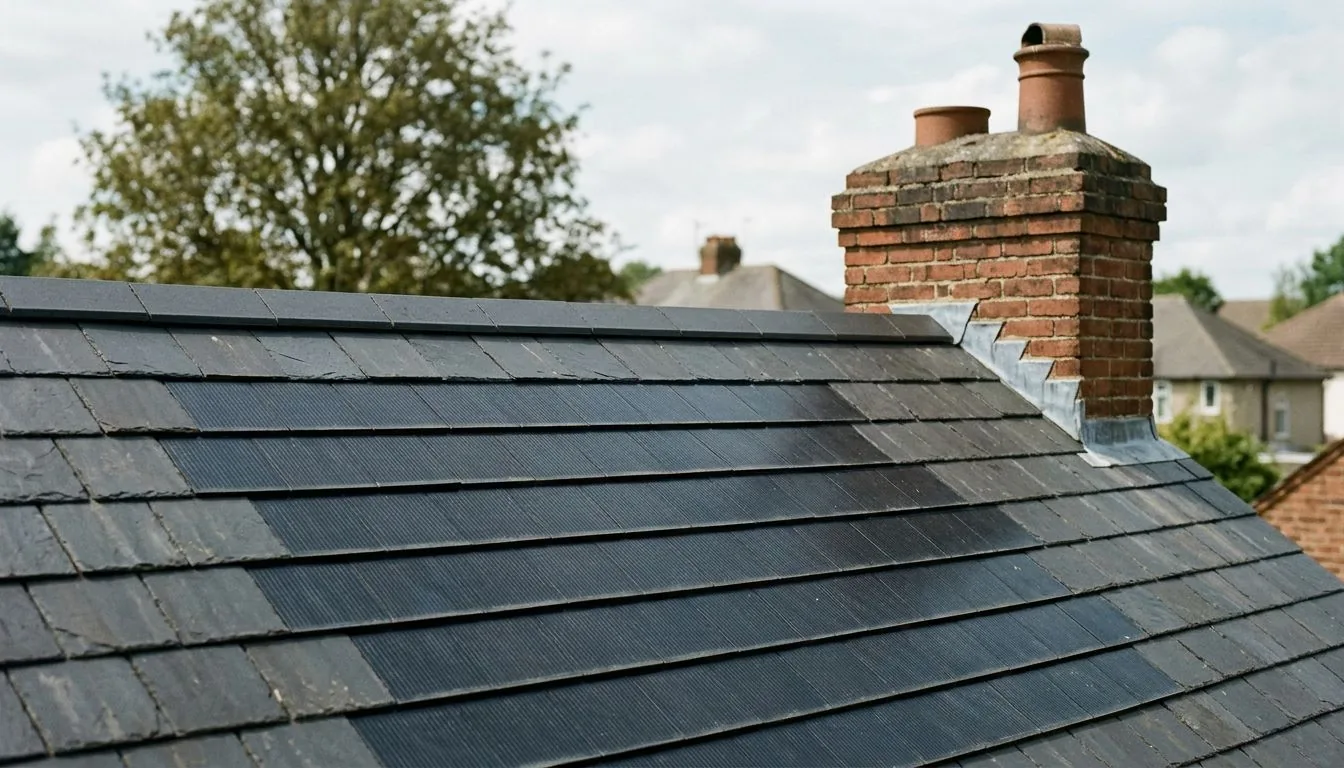
Solar roof tiles are roof coverings with solar cells built in. They give a neat look without racks of panels on top. However, they cost more, so you need a clear reason to choose them. This guide covers cost, output, warranty and planning.
Solar roof tiles UK: how they differ from panels
Standard panels bolt on top of your existing roof. Solar tiles replace part of the roof covering, so they do two jobs at once. That is why they look tidy.
The trade-off is cost and flexibility. You pay for a roof covering and a power system together. Also, you cannot tilt tiles to a better angle, because they follow the roof slope.
| Feature | Solar roof tiles | Standard panels |
|---|---|---|
| Look | Flush with the roof | Sit above the roof |
| Cost per kW | Noticeably higher | About £1,650 to £2,100 per kW (DESNZ, 2025/26) |
| Roof area needed | Usually more | About 18 to 20 m² for 4 kWp |
| Install job | Part of a roofing job | Usually a quicker fit |
| Best for | New roofs, strict planning | Sound roofs, best value |
Sources: DESNZ solar PV cost data.
What solar tiles cost compared with panels
A typical 4 kWp panel system costs about £6,500 to £8,500 fitted (October 2026), including 0% VAT. That zero rate ends on 31 March 2027. For the detail, read what fitting solar panels costs, or see what solar panels cost and save.
Tile quotes vary widely, because each product and roof is different. For that reason we do not print a tile price here. Ask for an itemised quote that separates the roofing work from the solar kit.
Then compare the cost of each kWh the system makes. A system that costs far more but makes about the same power has a much longer payback. On our standard model, a standard 4 kWp system pays back in about 11 to 15 years, typically 13.
Sources: HMRC VAT guidance.
Output and efficiency
Most panels sold for UK homes today convert about 20% to 23% of sunlight to electricity. Tiles are usually less efficient per square metre. As a result, you may need more roof to reach the same size.
Check each product’s datasheet for output per tile, the warranty and the installer’s certification. Our guide to mono, poly and thin-film panels explains the cell types behind both options.
Because the angle is fixed, a south-facing roof matters even more. In the UK a tilt of 35 to 40 degrees facing south works best. East or west roofs make roughly 80% as much.
When solar tiles are worth the extra money
Tiles make sense in a few cases.
- You need a new roof anyway. The extra cost over a plain new roof is smaller than the full price of a tile system.
- Planning is tight. A conservation area or an area that needs a particular roof material can rule out visible panels.
- You are building new. Tiles fit into the design from the start. See our notes on solar on new-build homes.
- Looks come first. Some owners pay the premium for the finish.
On a sound roof with no limits, standard panels win on value. For most homes, solar panel systems for homes are the better starting point. For the wider picture, see home solar panel systems explained.
Planning, conservation areas and listed buildings
In England, rooftop solar on a house is usually permitted development, with panels no more than 200 mm proud of a pitched roof. Listed buildings still need consent. In a conservation area, check with your council first.
Solar tiles may help where visible panels fail. However, every council decides on its own terms, so ask before you buy. Read the rules in our guide to planning permission rules for solar.
Local costs and support also differ. See Bristol solar costs and support and London solar costs and support for two areas with many conservation areas.
Scotland and Wales have their own rules, which England’s 2026 changes did not alter.
Sources: Planning Portal, SI 2026/896, legislation.gov.uk.
Buying a home that has solar tiles
Tiles can look like normal roofing, so you may miss them on a viewing. Look at the survey, the EPC and the seller’s papers. Then read buying a house that already has solar panels for the paperwork to ask for.
Frequently asked questions
Are solar roof tiles allowed in conservation areas?
Sometimes. It depends on your council and the product. Ask for pre-application advice before you order.
Do solar tiles work as well as panels?
They work, but usually with lower output per square metre. The fixed roof angle also limits them. Check the datasheet for your product.
Do solar tiles qualify for the Smart Export Guarantee?
Yes, if an MCS-certified installer fits an MCS-certified product. Without an MCS certificate you cannot be paid under the Smart Export Guarantee.
What warranty should I expect?
Expect a product warranty of at least 12 years and a 25 to 30 year performance guarantee on standard panels. Tiles vary, so read the warranty before you sign.
Do solar tiles add value to my home?
They may help sale appeal, but the extra cost is unlikely to come back in full. Treat planning and looks as the real reasons to buy.
Sources: Smart Export Guarantee, GOV.UK.
Not sure which option fits your roof? Get free quotes from MCS-certified installers and compare tiles with panels.