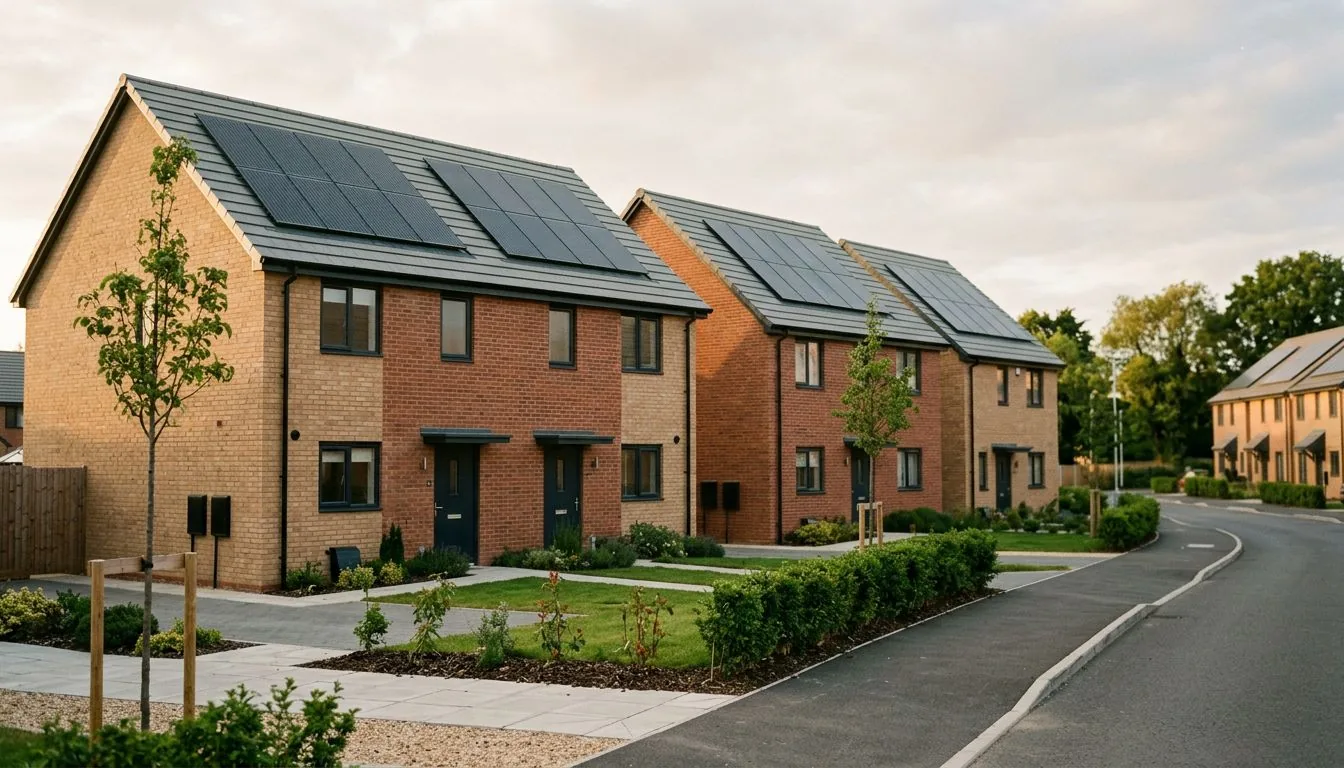
Solar panels on new builds are now a normal part of many new homes. Developers often fit them to meet energy rules, so you may buy a house that already has a system on the roof. This guide explains the rules behind that, then gives you a checklist for your solicitor.
Why solar panels on new builds are so common
England’s Part L 2021 rules took effect in June 2022. They require new homes to emit about 31% less carbon than the older standard. Because panels are a cheap way to hit that target, many builders added them.
Wales has its own building regulations, so the details differ there. Scotland uses Section 6 of its building standards. Northern Ireland also sets its own rules. If you want to know what a roof can generate in each place, see our pages on what solar generates in Wales, what solar generates in Scotland and solar panels in Northern Ireland.
Sources: Approved Document L, GOV.UK.
The Future Homes Standard: what changes in 2027
The Future Homes Standard is the 2026 update to Part L. The government published it on 24 March 2026. Most of it comes into force on 24 March 2027.
It adds a new requirement, called L3, for on-site renewable electricity on new homes. In practice that means solar panels on most roofs. Industry guides report that the array should be about 40% of the ground floor area, but check Approved Document L for the exact test.
However, there is a transition period. A scheme that gave building control notice before 24 March 2027 can still build to the older rules. Work must then start before 24 March 2028. As a result, homes sold in 2027 and 2028 will vary.
| Rule | Starts | What it means for solar |
|---|---|---|
| Part L 2021 | June 2022 | About 31% less carbon, so panels are common |
| Future Homes Standard | 24 March 2027 | New on-site renewable electricity requirement (L3) |
| Transition end | Work starts by 24 March 2028 | Older rules still apply to some schemes |
Sources: Building Circular 01/2026, GOV.UK.
What a new-build solar system usually includes
Most new-build systems are small and simple. A typical 4 kWp system uses 9 to 10 panels and about 18 to 20 m² of roof. Our guide to home solar panel systems explained shows how the parts fit together.
Many new homes also have an air source heat pump and strong insulation. Some have an electric vehicle charge point. Batteries are rarer, although an all-electric home uses a lot of power in the evening.
Ask the developer for the exact kWp, the panel model and the inverter model. Then you can compare the system with our guide to how the leading home batteries compare. A hybrid inverter makes it easy to add storage later. A plain string inverter may need extra kit.
A buyer’s checklist for new-build solar
Ask your solicitor or the developer to confirm these points before you exchange.
- MCS certificate. You need one to get paid under the Smart Export Guarantee. Ask for a copy.
- Panel and inverter details. Get the brand, model, kWp and warranty papers.
- Network operator notice. Check that the installer told your network operator about the system.
- Monitoring login. Make sure you can see the app and the data.
- Ownership. Confirm that you own the panels outright, with no lease or rent-a-roof deal.
- Roof warranty. Check that the roof guarantee still covers the fixings.
- Export tariff. Find out if the developer set one up, and whether you can switch.
If you are buying an older home with panels instead, read about what to check when a home comes with panels.
Flat roofs, planning and support
Many new estates use flat roofs or low pitches. Panels there sit on frames, which changes output and cost. See our notes on flat roof mounting options for the trade-offs.
Planning is mostly settled at the design stage. If you later want to add panels, read when solar needs planning consent. The rules for roofs differ across the four nations.
You may also wonder about money. A new-build owner rarely gets a grant, because the system is already part of the build. For a wider view of government support for solar panels, see our grants guide. If you prefer a different look, compare solar tiles versus panels.
Frequently asked questions
Do I need to do anything to get paid for exports?
Yes. You must choose a Smart Export Guarantee tariff, because the developer may not have set one up. Each supplier sets its own rate, so compare offers. For example, Outgoing Octopus pays 12p/kWh, but only if you also buy electricity from Octopus (October 2026).
Can I add a battery to a new-build system?
Usually, yes. A hybrid inverter takes a battery with little change. With a plain string inverter you may need an AC-coupled battery. Adding a 5 kWh battery at the same time as the panels typically adds £2,500 to £4,000.
What if the developer promised solar and did not fit it?
Check the planning conditions first. Some consents require panels. If the developer did not comply, tell your local planning authority. Your solicitor can also raise it before you complete.
Does a builder warranty cover the solar system?
Often not. Standard new-build warranties focus on the structure. The panel maker’s warranty and the MCS certificate are your main protection. Expect a product warranty of at least 12 years and a 25 to 30 year performance guarantee, and check the datasheet.
Does solar help my mortgage or EPC?
Panels improve the energy rating. A better rating can open green mortgage products with some lenders. Ask your broker, because deals change often.
Sources: Smart Export Guarantee, GOV.UK, Outgoing Octopus.
Want to know what a full system would cost on your own home? Get free quotes from MCS-certified installers.