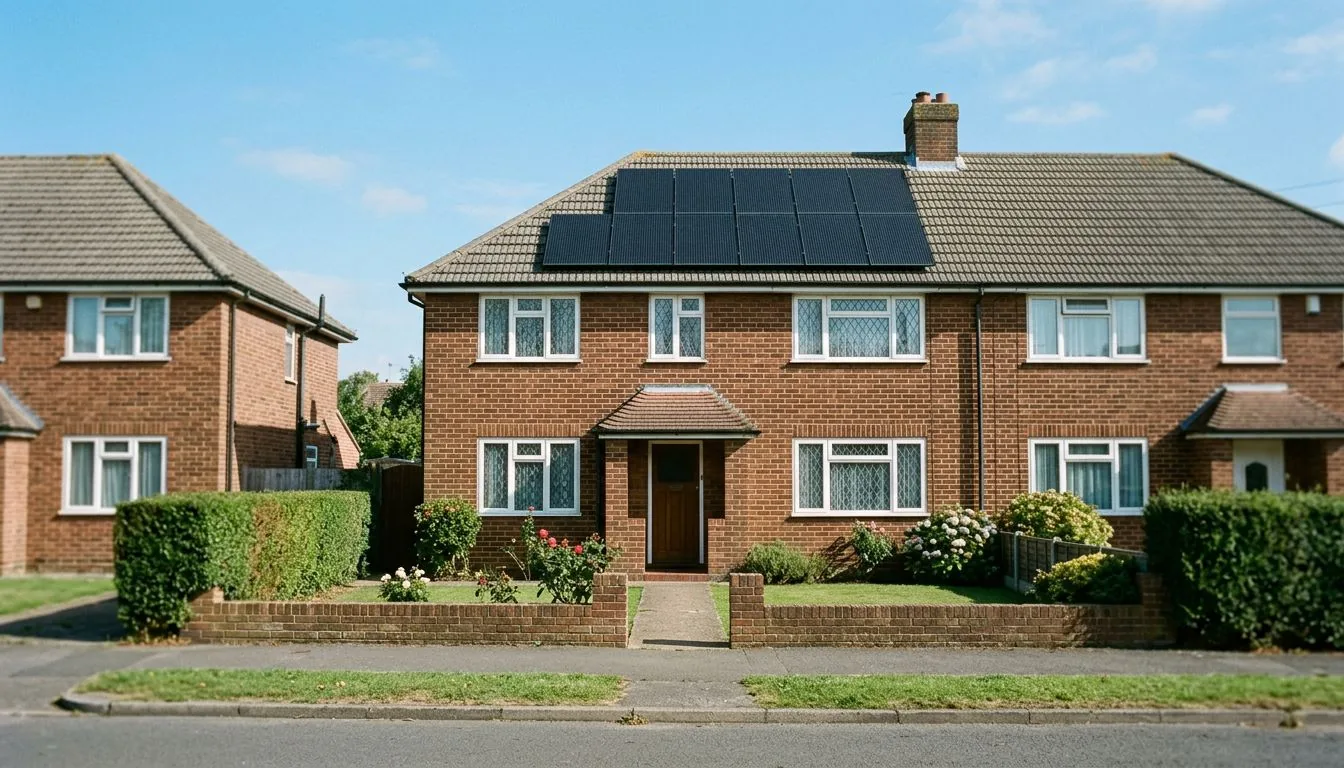
Quick answer: a typical 4 kWp home solar system costs about £6,500 to £8,500 fitted (October 2026), including 0% VAT. On our standard model it saves and earns roughly £590 a year, so it pays for itself in about 13 years.
What is a home solar panel system?
A home solar panel system turns daylight into electricity for your house. Panels on the roof make direct current. Because your appliances need alternating current, an inverter converts it. You use what you need and export the rest to the grid.
Most systems share the same core parts. Panels, an inverter, a mounting frame and cabling do the main work. However, many homeowners also add a battery, which stores spare daytime power for the evening.
Our guide to solar panel systems for homes explains each part, the common sizes and what to expect on installation day. It also shows how home solar power systems differ by roof type, since every roof is different.
A typical UK home uses about 2,700 kWh of electricity a year (Ofgem's medium figure). A 4 kWp system makes about 3,600 kWh a year on our standard assumption. That is more than the average home uses, although much of it arrives when you are out.
How much do home solar panels cost?
Prices depend on system size, roof type and whether you add a battery. Because costs move, the table shows typical fitted prices in October 2026. All figures include 0% VAT, which applies until 31 March 2027.
| System | Panels (430–450 W) | Typical fitted cost |
|---|---|---|
| 3 kWp | 7 | £5,500–£7,000 |
| 4 kWp | 9–10 | £6,500–£8,500 (typical £7,500) |
| 5 kWp | 11–12 | £7,500–£9,500 |
| 6 kWp | 13–14 | £9,000–£11,000 |
| 4 kWp plus 5 kWh battery, fitted together | 9–10 | £10,000–£14,000 (typical £11,500) |
Government figures based on MCS installs put the average home retrofit at roughly £1,650 to £2,100 per kW (DESNZ, 2025/26). Scaffolding, roof complexity and bird-proofing can add to the total, so ask every installer for an itemised quote, because extras differ from home to home.
The zero rate of VAT saves roughly £300 to £400 on a typical 4 kWp system compared with the old 5% rate. However, after 31 March 2027 the rate goes to 5%. Our guide to solar panel installation costs breaks the price down further.
How much can home solar panels save you?
On our standard model, a 4 kWp system costing about £7,500 saves and earns roughly £590 a year at October 2026 prices. As a result, it pays for itself in about 13 years, or roughly 11 to 15 years depending on price, roof and export tariff.
Here is where the £590 comes from. Specifically, the system makes about 3,600 kWh in year one. We assume you use 30% of that at home, which saves about £284 at 26.32p per kWh. You export the other 70% and earn about £302 at 12p per kWh.
Adding a 5 kWh battery raises the annual benefit to about £740. However, on a flat-rate tariff it lengthens payback to typically 15 to 16 years, because the battery adds £2,500 to £4,000 to the bill. Batteries pay back faster on a cheap overnight tariff, which this model leaves out. Read more about solar battery storage costs and benefits.
Over 25 years the no-battery system returns roughly £13,800, about £6,300 more than it cost, at today's prices. For a fuller breakdown, see solar panel costs and savings in the UK. You can also read whether solar panels are worth it in the UK.
What the model assumes
- The system makes 900 kWh per kWp a year, a cautious figure for a typical UK roof.
- You use 30% of your solar power at home (60% with a battery). This is our assumption, not a measured figure.
- Imported electricity costs 26.32p per kWh, the Ofgem price cap for October to December 2026, with no future price rises.
- You export at 12p per kWh, a rate available if you import from the same supplier. Open-market rates are about 3p to 6p.
- Panels lose 0.5% of output a year. The model leaves out the standing charge, maintenance, inverter replacement and finance costs.
Export rates matter a great deal. With an open-market rate of 4.1p instead of 12p, payback stretches to about 20 years. In contrast, a higher import price shortens it.
Meanwhile, two dates could move the numbers. From 1 April 2027, 5% VAT returns on installs, which adds about £375 to a £7,500 job. VAT on electricity is due to return the same day, which would raise the value of each unit you use yourself by about 5%.
How big a home solar system do you need?
A typical home panel measures about 1.76 m by 1.13 m, weighs about 22 kg and has a rating of around 430 to 450 W. So a 4 kWp system needs 9 to 10 panels and about 18 to 20 m² of roof.
The right size depends on your electricity use, your roof and your budget. A larger system makes more power, although the extra panels only pay back if you use or sell that power. Try our solar panel calculator to estimate a size for your home.
Roof direction also matters. In the UK the best angle is about 35 to 40 degrees, facing due south. Anywhere from 20 to 45 degrees costs you no more than about 4%.
East- or west-facing panels produce roughly 80% of a south-facing array, and they generate more in the morning or evening. North-facing roofs produce only about half as much. For a typical roof, we assume about 900 kWh per kWp a year. A south-facing roof in southern England can manage 1,000 or more, while a shaded or east-west roof in the north may make nearer 750 to 800.
Solar panel grants and schemes by nation
Since most UK homeowners pay for solar themselves, the main incentive is 0% VAT on installation until 31 March 2027. Grants do exist, but they depend on where you live and your household income. Our page on solar panel grants available in the UK tracks the details.
England
ECO4 closes on 31 December 2026 and installers are finishing existing jobs, so don't plan on it for a new project. Meanwhile, the Great British Insulation Scheme closed on 31 March 2026.
The government's Warm Homes Plan (January 2026) promises low- and zero-interest loans for solar and batteries, plus fully funded installs for low-income households. Most of the schemes open from 2027, however, so check gov.uk before applying. Your council may also run a Warm Homes: Local Grant for low-income households, so ask it directly.
Scotland
Home Energy Scotland no longer funds standard solar panels or batteries. The only solar technology it still supports is hybrid PV-T panels, through an interest-free loan of up to £5,000. Read our guide to solar panels in Scotland for local yield and planning rules.
Wales
The Welsh Government's Nest scheme can fit solar panels free for eligible lower-income households. However, whether you qualify depends on benefits or income, and your home's EPC rating. Nest decides which measures each home receives, so it cannot promise solar. See solar panels in Wales for more.
Northern Ireland
There is currently no general government grant for home solar panels in Northern Ireland. Check nidirect for any new scheme, since the position may change. Our page on solar panels in Northern Ireland covers export payments and planning.
Get paid for spare power: the Smart Export Guarantee
Suppliers in Great Britain must pay you for electricity you export under the Smart Export Guarantee. There is no fixed rate, because each supplier sets its own, so it pays to compare. You also need an MCS-certified installation to qualify.
For example, Outgoing Octopus pays 12p per kWh (October 2026), but only if you also buy your electricity from Octopus on an eligible import tariff. Open-market rates are about 3p to 6p per kWh.
Northern Ireland has no Smart Export Guarantee. Power NI currently pays 11.88p per kWh for exported electricity (October 2026 to September 2027), at a rate approved each year by the Utility Regulator. Because the rate can change, check with Power NI before you rely on it.
Do home solar panels need planning permission?
In England, since 27 August 2026, rooftop solar on a house is usually permitted development. Panels can sit no more than 200 mm proud of a pitched roof and no higher than the ridge, or up to 600 mm above a flat roof. Listed buildings and some conservation-area elevations need consent.
Scotland has its own rules, and most rooftop solar on houses falls under permitted development there if it projects no more than 1 metre. Meanwhile, Wales follows its own rules, which England's August 2026 reforms did not change. Northern Ireland's rules are similar to the old English ones: 200 mm, and not above the ridge.
Check with your council if you live in a listed building, a conservation area or an Article 4 area, because the rules differ there. Your installer should confirm the position for your address before work starts.
How to get home solar panel quotes
Getting quotes takes a few minutes because you fill in only one form. Use the form at the top of this page or on our contact page, and installers will contact you to arrange a survey. You then compare their quotes and choose.
- Tell us about your home. Give your postcode, address and the kind of system you want.
- Book surveys. Installers check your roof, your electrics and where the inverter can go.
- Compare like with like. Look at price per kWp, panel and inverter brands, warranties, battery options and scaffolding costs.
- Check credentials. Choose an MCS-certified installer that belongs to a consumer code.
- Sign and install. A roof system is often fitted in one or two days, and your installer registers it for export payments.
Use an MCS-certified installer, because without an MCS certificate you can't get paid under the Smart Export Guarantee. Ready to start? Request free installer quotes in a few minutes.
Home solar panels across the UK
Sunshine varies across the UK, although less than most people expect. Using the EU's PVGIS solar model, 1 kWp of south-facing panels at a 35 degree tilt produces about 850 kWh a year in Glasgow and about 1,025 kWh in London.
Read our local guides on solar panels in Scotland, solar panels in London, solar panels in Manchester and solar panels in Bristol. Each one gives a local yield figure, because yields and rules differ by area.
- Solar panels in Scotlandabout 870 kWh/kWp
- Solar panels in Walesabout 950 kWh/kWp
- Solar panels in Northern Irelandabout 875 kWh/kWp
- Solar panels in London1,025 kWh/kWp
- Solar panels in Manchester885 kWh/kWp
- Solar panels in Birmingham970 kWh/kWp
- Solar panels in Leeds945 kWh/kWp
- Solar panels in Bristol1,020 kWh/kWp