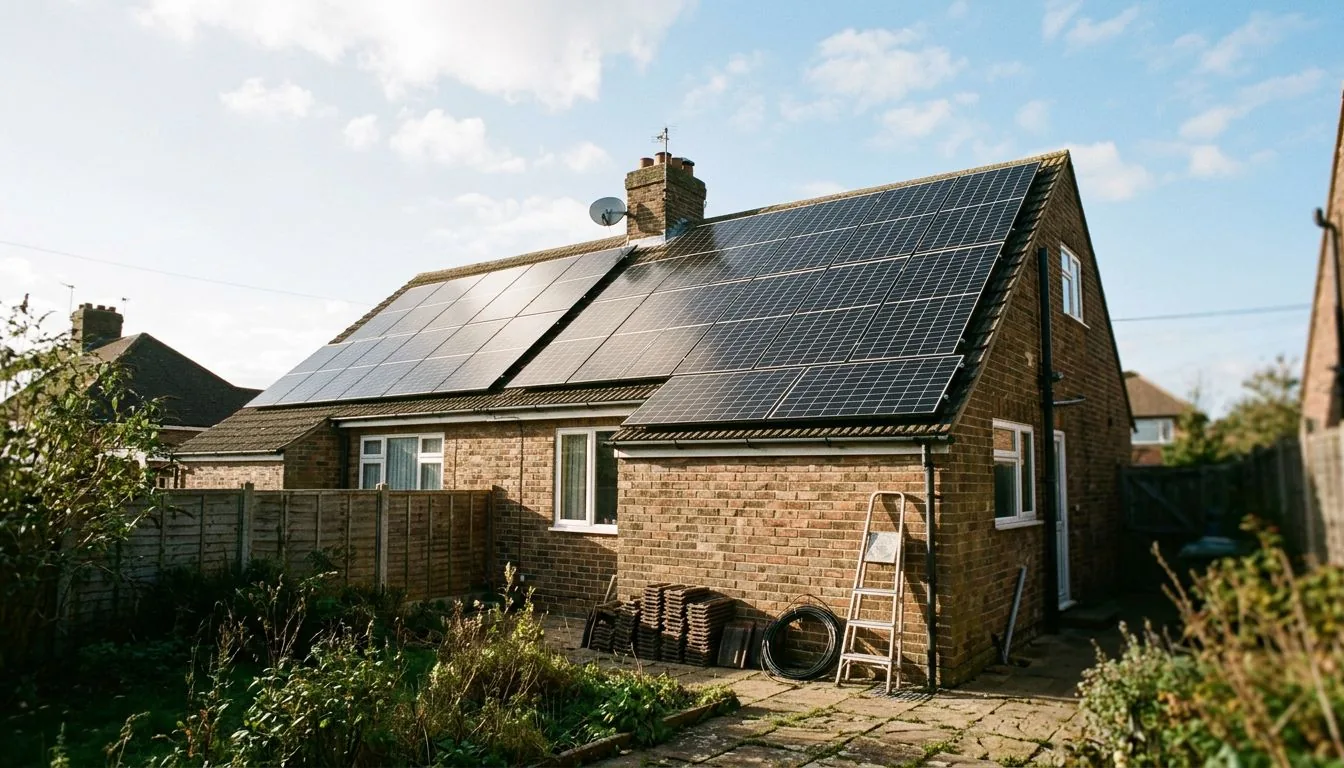
Solar panel output in the UK depends on three things: where you live, which way your roof faces and the time of year. For a typical UK roof we assume about 900 kWh per kWp a year, so a 4 kWp system makes about 3,600 kWh. This guide shows the monthly pattern, the city-by-city differences and how to check your own system.
The figures come from the EU’s PVGIS solar model, retrieved in October 2026. They assume panels with 14% system losses, because real systems lose some power in cables and the inverter.
How much do solar panels produce each month?
The table below uses PVGIS data for the traditional centre of England, with panels facing due south at 35°. That is an ideal roof. Therefore, the last column adjusts a 4 kWp system to our typical-roof figure of 900 kWh per kWp.
| Month | 3 kWp (kWh) | 4 kWp (kWh) | 6 kWp (kWh) | 4 kWp, typical roof (kWh) |
|---|---|---|---|---|
| January | 110 | 147 | 220 | 134 |
| February | 159 | 212 | 318 | 193 |
| March | 261 | 348 | 522 | 317 |
| April | 329 | 439 | 658 | 400 |
| May | 359 | 478 | 717 | 436 |
| June | 353 | 471 | 706 | 429 |
| July | 365 | 486 | 729 | 443 |
| August | 325 | 433 | 650 | 395 |
| September | 278 | 371 | 557 | 338 |
| October | 190 | 253 | 380 | 231 |
| November | 132 | 176 | 264 | 161 |
| December | 102 | 135 | 203 | 123 |
| Year | 2,963 | 3,950 | 5,925 | 3,600 |
The best months are May to July, as you would expect. In those months a 4 kWp system on a typical roof makes about 14 kWh a day on average. In December the same system makes about 4 kWh a day.
Because December output is roughly a quarter to a third of June’s, a yearly total hides a big seasonal swing. Our guide to solar output on grey days covers the winter months in detail.
Output by city and region
Location changes the yield, because the north gets less sun. The table shows PVGIS figures for 1 kWp of south-facing panels at a 35° tilt. Multiply by your system size in kWp for a rough yearly total.
| Place | Yield (kWh per kWp a year) | 4 kWp system (kWh a year) |
|---|---|---|
| Plymouth | 1,100 | About 4,400 |
| Swansea | 1,040 | About 4,160 |
| Cardiff | 1,030 | About 4,120 |
| London | 1,025 | About 4,100 |
| Bristol | 1,020 | About 4,090 |
| Birmingham | 970 | About 3,870 |
| Leeds | 945 | About 3,790 |
| Belfast | 920 | About 3,670 |
| Edinburgh | 915 | About 3,660 |
| Manchester | 885 | About 3,540 |
| Glasgow | 850 | About 3,400 |
| Inverness | 805 | About 3,220 |
Southern England and south Wales get the most. Here, for example, what solar generates in Bristol shows a south-west yield of about 1,020. Scotland sits lower, at about 805 in Inverness to 935 in Dundee. Read more at solar panels in Scotland.
Wales, meanwhile, ranges from about 805 in Bangor to 1,040 in Swansea, depending on the site. See solar panels in Wales for the detail.
Why real output is lower than the model
These figures assume an ideal roof with no shade, yet few roofs are ideal. Real roofs vary, and that is why we use 900 as our house figure instead of PVGIS’s 990 for central England. South-east and south-west roofs make about 93–95% of the ideal figure. East and west roofs make about 78–80%.
A cautious estimate of 850 kWh per kWp is still reasonable for a shaded or north-leaning roof. A south-facing roof in southern England can manage 1,000 or more. A shaded or east-west roof in the north may sit nearer 750–800.
| Orientation or tilt | Share of south-facing, 35° output (London) |
|---|---|
| South, 35° | 100% |
| South, 20° or 45° | 96–100% |
| South-east | 95% |
| South-west | 93% |
| East or west, 35° | 78–80% |
| Flat (no tilt) | 83% |
| North, 35° | 53% |
In the UK the best angle is about 35–40° facing due south. Anywhere from 20° to 45° costs you no more than about 4%, so exact tilt is not critical. Our guide to ground-mounted solar arrays explains how an unshaded ground array can reach an ideal angle.
Other things lower output too, since shade and dirt both block light. Shade, dirt and a failing inverter all take a share. Good panels also lose roughly half a percent of output a year. For how that compares with the headline number, see what panel efficiency figures mean. Note that efficiency tells you how much roof you need, not how much a system makes.
How to check your system is performing
Use your inverter’s app to compare each month with the table above. Allow for normal weather swings, because one cloudy month can sit well below the average.
Look into it if you see any of these:
- A month far below the same month last year
- Zero output on a bright day
- A fault light or error code on the inverter
- A steady fall that weather does not explain
Start by ruling out new shade, such as a tree that has grown, because that is a common cause. Next, check that the panels look clean. If neither explains it, call your installer. Our maintenance guide lists the usual causes.
Turn output into your own estimate
For example, the quickest way to estimate your own output is to multiply your system size by your yield. A 5 kWp system on a typical roof makes 5 × 900 = 4,500 kWh. To size a system from your electricity use, estimate your system size with the calculator. To see how many panels that means, read sizing a system to your usage.
For systems of different sizes, see the residential solar panels overview.
Sources: EU PVGIS, PVcalc, SARAH2 database, retrieved October 2026.
Frequently Asked Questions
Q: How much electricity does a 4 kWp system make in a year? A: About 3,600 kWh on a typical UK roof. A south-facing roof in southern England can make 4,000 kWh or more. A shaded or east-west roof in the north may make nearer 3,000–3,200 kWh.
Q: Why does my output change so much from day to day? A: Cloud is the main cause. A bright day can make several times what a dull day does. Compare months rather than days to judge your system.
Q: Do solar panels work in winter? A: Yes, but at a much lower level. December output is roughly a quarter to a third of June’s in most of England and Wales, and under a fifth in Glasgow.
Q: Does rain clean my solar panels? A: Rain removes light dust. It does not remove droppings or moss, so check the panels from the ground now and then.
Q: Can solar panels make power at night? A: No. Panels need daylight. At night your home uses a battery if you have one, or the grid.