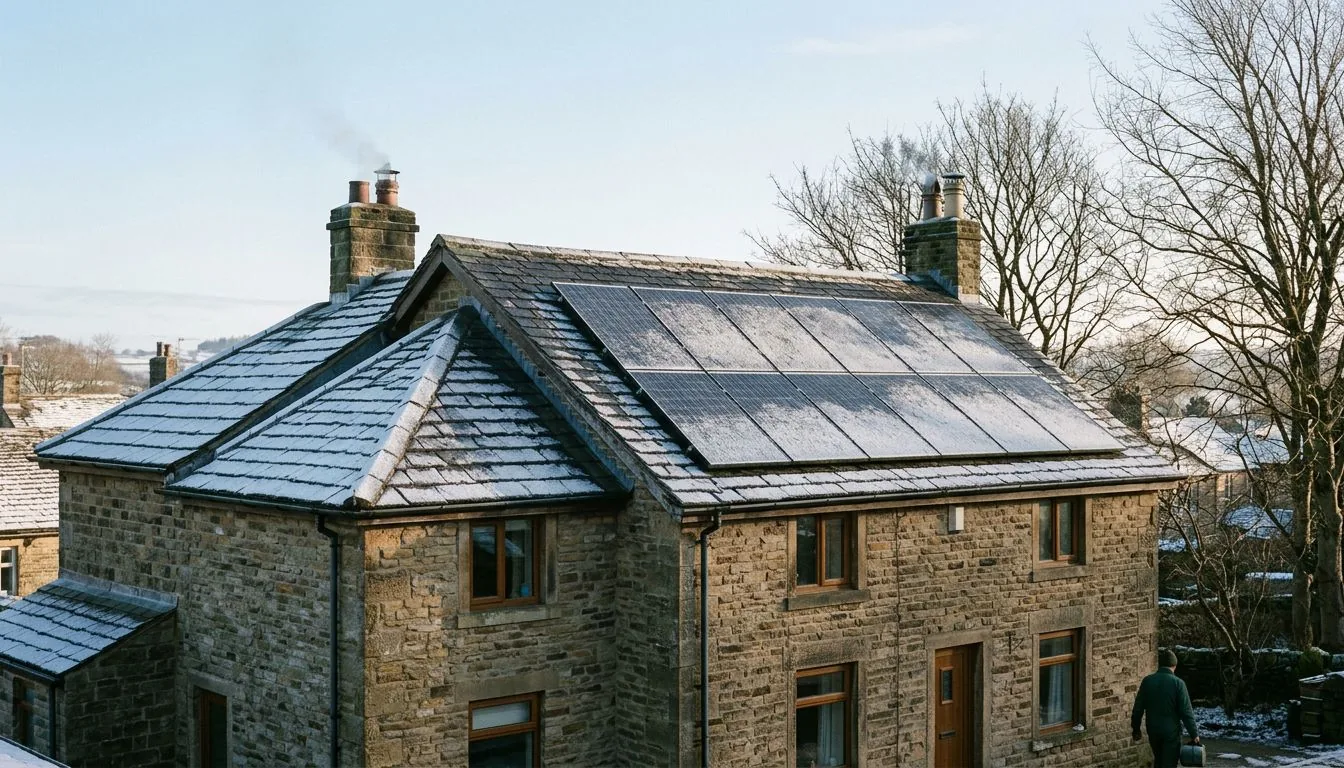
Do solar panels work in winter? Yes, they do. Panels make electricity from daylight, so they keep working through cold, grey UK months. Output is lower, though, and it helps to know by how much. Here are the real numbers.
How do solar panels work without direct sun?
Solar panels turn light into electricity. They use diffuse daylight as well as direct sunshine, so cloud reduces output rather than stopping it. On the darkest, foggiest days output drops close to nothing.
Cold is not the problem. In fact, panels run slightly more efficiently when cool. The real issue in winter is that days are short and the sun sits low.
How much less do solar panels make in winter?
We used the EU’s PVGIS solar model to compare June with December. The figures assume south-facing panels at a 35° tilt. Real roofs that face another way, or are shaded, make less.
The table shows a 4 kWp system, which is a typical size for a home.
| Place | June (4 kWp) | December (4 kWp) | December as a share of June |
|---|---|---|---|
| London | about 490 kWh | about 150 kWh | about 31% |
| Cardiff | about 515 kWh | about 132 kWh | about 26% |
| Manchester | about 435 kWh | about 114 kWh | about 26% |
| Belfast | about 461 kWh | about 109 kWh | about 24% |
| Edinburgh | about 440 kWh | about 91 kWh | about 21% |
| Glasgow | about 438 kWh | about 78 kWh | about 18% |
So December output is roughly a quarter to a third of June’s. In Glasgow it falls to under a fifth. A 4 kWp system in London makes about 150 kWh in December.
At 26.32p a unit, that is worth about £40 if you use every kilowatt-hour yourself. In Glasgow, 78 kWh is worth about £21. That is the Ofgem price cap average for October to December 2026.
Sources: PVGIS solar tool; Ofgem price cap, October to December 2026.
Why do winter bills still fall?
The useful question is not how much panels make, but how much they save. In winter you use more power, so panels cover only a small share of your bill. Even so, every unit you generate is one you don’t buy.
Over a full year, a typical UK roof makes about 900 kWh per kWp. That means about 3,600 kWh from a 4 kWp system. A south-facing roof in southern England can manage 1,000 or more. You can estimate your own figure with our solar panel calculator or see how much a system generates month by month.
Does cloud really matter in the UK?
Less than you might think. In the north-west of England, for example, rainfall is a popular objection. Yet PVGIS gives about 885 kWh per kWp a year for Manchester. London gets about 1,025.
So the difference between a wet city and a drier one is modest. Take a look at solar panels in Manchester for local detail. Leeds, a cloudy northern city, gets about 945 kWh per kWp. See solar panels in Leeds for more.
Scotland’s yield is lower, but still useful. Read Scotland solar costs and support for northern winter yields.
How can you get more from winter solar?
Several small steps help.
Face south. Anywhere from 20° to 45° costs you no more than about 4%. East- or west-facing panels make about 80% as much, and north-facing roofs only about half. Read the best angle and direction for panels for more.
Use power at midday. In winter, panels peak around the middle of the day. So run the washing machine or dishwasher then. As a result, you use more of your own solar.
Keep panels clear. Snow slides off most panels quickly, but don’t use anything hard to clear it. Our tips on looking after your panels cover cleaning and winter care.
Consider a battery. In summer you make more than you use. A battery stores that surplus for the evening. However, in winter it rarely fills from solar, so many people charge it from a cheap overnight tariff instead. Read about solar battery storage costs and benefits.
Are solar panels still worth it with weak winters?
Yes, for many homes. Winter output is small, but summer more than makes up for it. On our standard model, a 4 kWp system saves and earns about £590 a year. That pays back in about 13 years. For the full picture see solar panel systems for homes.
Frequently asked questions
Does snow affect solar panels?
Settled snow cuts output to near zero. However, snow usually slides off smooth, tilted glass fairly quickly. If you clear it, use something soft and never anything abrasive. Don’t climb onto a roof to do it.
Do panels work better on cold days?
Slightly. Panels run a little more efficiently when cool. A cold, bright day can therefore beat a warm, hazy one. The effect is small, though.
Can solar power my home fully in winter?
Rarely. Winter output is low and winter demand is high, so most solar homes still use the grid. That is fine. Solar cuts your bills across the year without needing to replace the grid.
Does solar still work in northern Scotland in winter?
Yes, but output is lower. In Glasgow, December output is under a fifth of June’s. Annual yield still ranges from about 805 kWh per kWp in Inverness to 935 in Dundee.
Is it worth getting solar just for the summer?
Panels work in every season, so it is not a fair question. Most savings come in summer, but winter output is real and it adds up.