Installing solar panels in the UK is quicker than most people expect. However, the weeks before the fitters arrive matter just as much as the days on your roof. This guide walks through every step, from the first survey to the day you switch on.
Installing solar panels in the UK: the six steps
Most home installs follow the same six steps. Each one has a clear purpose, and a good installer will explain it before it happens.
- Survey your roof and your electricity use.
- Design the system and agree a fixed quote.
- Check planning and building rules.
- Put up scaffolding and fit the panels, inverter and wiring.
- Test the system and sign it off.
- Notify your network operator and register for export payments.
From signing the quote to switching on, expect a few weeks. The time on your roof is short because the paperwork and scheduling take most of the calendar.
Step 1: The survey
The survey sets the size and layout of your system. An installer looks at your roof, your fuse board and your meter. They also ask how much electricity you use and when.
The roof check covers its direction, pitch, condition and any shade from trees or chimneys. Because a south-facing roof gives the most power, direction matters. Our guide to the best angle and direction for panels shows how little you lose on an east or west roof.
Ask the surveyor about roof repairs now. If your tiles are tired, fixing them after the panels go up means paying for scaffolding twice.
Step 2: Design and quote
Next the installer designs the layout and sends a written quote. It should list the panel brand and model, the inverter, the total size in kWp and any battery. It should also say what is in the price and what is not.
A typical home panel measures about 1.76 m by 1.13 m and makes around 430–450 W. A 4 kWp system therefore needs 9–10 panels and about 18–20 m² of roof. See how big a solar panel is to check that your roof has room.
On price, a typical 4 kWp system costs about £6,500–£8,500 fitted, as at October 2026. Solar panels fitted to homes are zero-rated for VAT until 31 March 2027, and after that the rate goes to 5%. For a full breakdown, read our guide to solar panel installation costs. To see what that cost buys back in lower bills, read what solar panels cost and save.
Get at least three quotes, and compare the same system size each time. Our free quote service matches you with local installers so you can do this in one go.
Sources: HMRC VAT manual (VENSAV2083), DESNZ solar PV cost data.
Step 3: Planning and building rules
Most home installs do not need a planning application. In England, since 27 August 2026, rooftop solar on a house is usually permitted development. Panels on a pitched roof must stick out no more than 200 mm and sit no higher than the highest part of the roof.
On a flat roof, the highest part of the array can rise up to 600 mm above the roof. Listed buildings still need consent. In a conservation area, check with your council, because some elevations facing a road have extra limits. Our guide to when solar needs planning consent covers this in detail.
The other nations have their own rules. Scotland allows most rooftop solar that projects no more than 1 metre. Wales and Northern Ireland both use a 200 mm limit on the house. For Scotland, see Scotland solar costs and support, and for Northern Ireland, see what solar generates in Northern Ireland.
Building standards are separate from planning. Your installer should handle them, but ask how. In Scotland your council’s building standards team runs that process, while in Northern Ireland it is Building Control, so check with them if your installer is unsure.
Sources: SI 2026/896 on legislation.gov.uk, Welsh Government guidance on solar panels, Scottish Government Circular 1/2024.
Step 4: Installation day
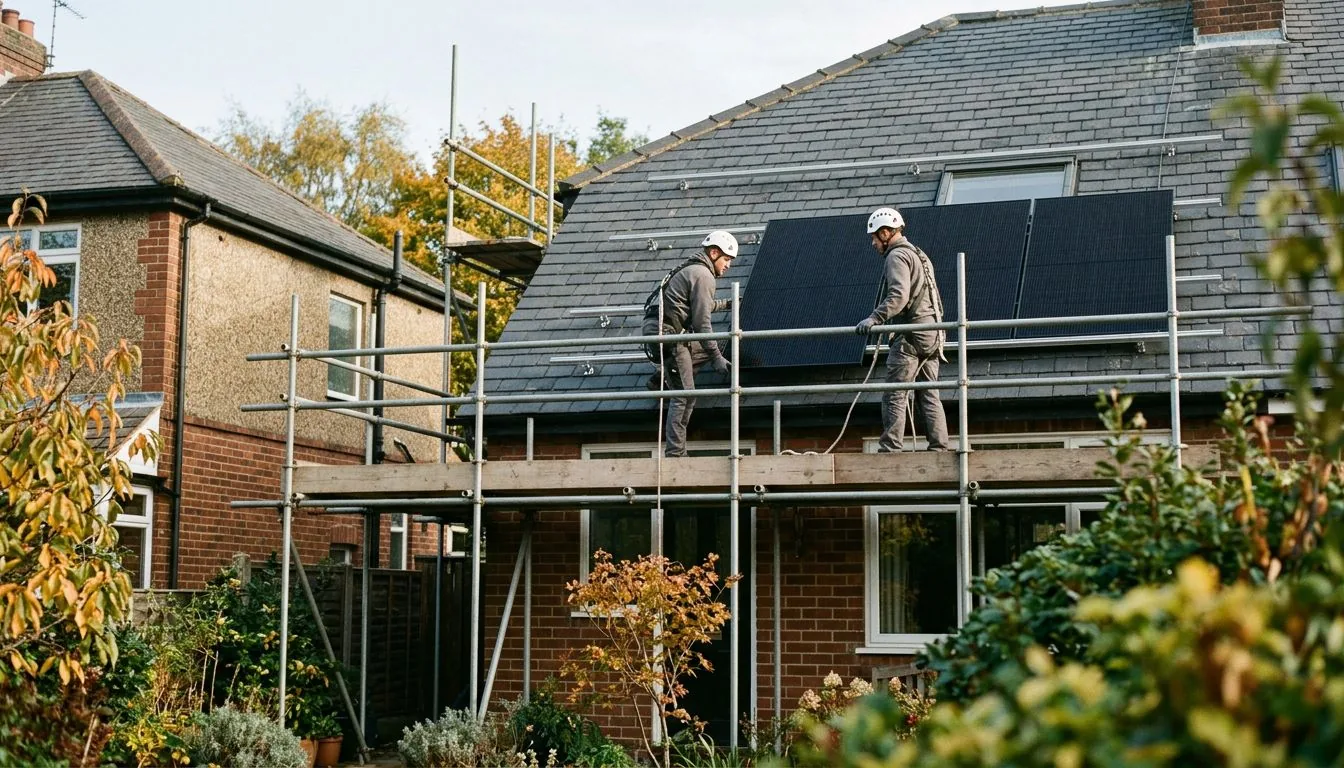
The work usually starts with scaffolding. Because the fitters need safe access, the scaffold often takes as long to build as the panels take to fit. The whole job is often a one- or two-day visit, although a large roof or a battery can add time.
Every domestic system has the same parts: panels, rails, an inverter and wiring. See our guide to solar panel systems for homes for how they fit together. Here is what the team does on site:
- They fix mounting rails to your roof with brackets that sit under or between the tiles.
- They clamp the panels onto the rails and wire them into strings.
- They mount the inverter, often in a loft or garage, and connect it to your fuse board.
- They fit an isolator switch, and a battery if you ordered one.
Expect some noise, a few short power cuts and a tidy-up at the end. You do not need to leave the house.
Never let anyone work on your roof without proper edge protection. If a quote leaves out scaffolding, ask why, because working from ladders is a warning sign.
Step 5: Testing and sign-off
Before leaving, the installer tests the circuits and checks that the inverter runs. They should show you how to read the display and how to turn the system off safely. Make sure you leave with a handover pack.
That pack should include the system design, the product datasheets and warranty papers, and the electrical test results. It should also include your MCS certificate, which is the proof of a certified install. Keep these in a safe place, since a buyer will ask for them when you sell.
Step 6: Grid notification and export payments
Your network operator must know about any generator you connect to the grid. Your installer normally handles this for you. For small systems it usually happens within 28 days of switching on, while larger inverters may need approval first. Ask them to confirm it in writing.
Next, register for export payments. In Great Britain, the Smart Export Guarantee pays you for power you send back to the grid. However, you need an MCS-certified installation and installer to qualify, and a meter that measures your export.
There is no fixed rate, because each supplier sets its own. Compare the options, and see our guide to the main export tariffs before you choose.
Sources: gov.uk Smart Export Guarantee guidance, Ofgem SEG page.
Choosing an installer
Pick an MCS-certified installer, and check that they also belong to a consumer code. That protects your deposit and gives you a route to complain if something goes wrong. Without an MCS certificate you cannot claim export payments.
Be wary of anyone who pressures you to sign on the day. A fixed written quote, a named product list and a clear payment schedule are all signs of a sound company. If you wonder whether you could skip the installer, read what you can legally install yourself.
Also watch out for offers of “free” panels. Funded schemes exist, but they have strict rules, and ECO4 closes on 31 December 2026. Our guide explains whether free solar panels are really free.
What a battery changes
Adding a battery changes the job. A 5 kWh battery fitted with new panels typically adds £2,500–£4,000. Since 1 February 2024, home batteries have also been zero-rated for VAT, until 31 March 2027.
A battery needs more wall space and often a second visit from an electrician. Plan for that when you book. If you want one, ask the installer to price it as part of the same job, because fitting it later usually costs more.
Frequently asked questions
How long does it take to install solar panels?
Most home installs take one to two days on site. The scaffold, a large roof or a battery can add time. From signing the quote to switching on, expect a few weeks.
Do I need planning permission to install solar panels?
Usually not. In England, rooftop solar on a house is normally permitted development if it sticks out no more than 200 mm on a pitched roof. Check with your council if your home is listed or in a conservation area.
Do I need to be at home during installation?
You need to let the team in and agree where the inverter goes. After that, you can carry on with your day, although you will lose power for short spells.
Will installing solar panels damage my roof?
A competent team fixes brackets under or between tiles and seals any holes. Fix loose or cracked tiles first, and ask your installer for a written guarantee on the roof work.
Can I install solar panels myself?
You can do some of the work, but you cannot claim export payments without an MCS-certified installation. Electrical connection also has safety rules, so read the full guide before you start.