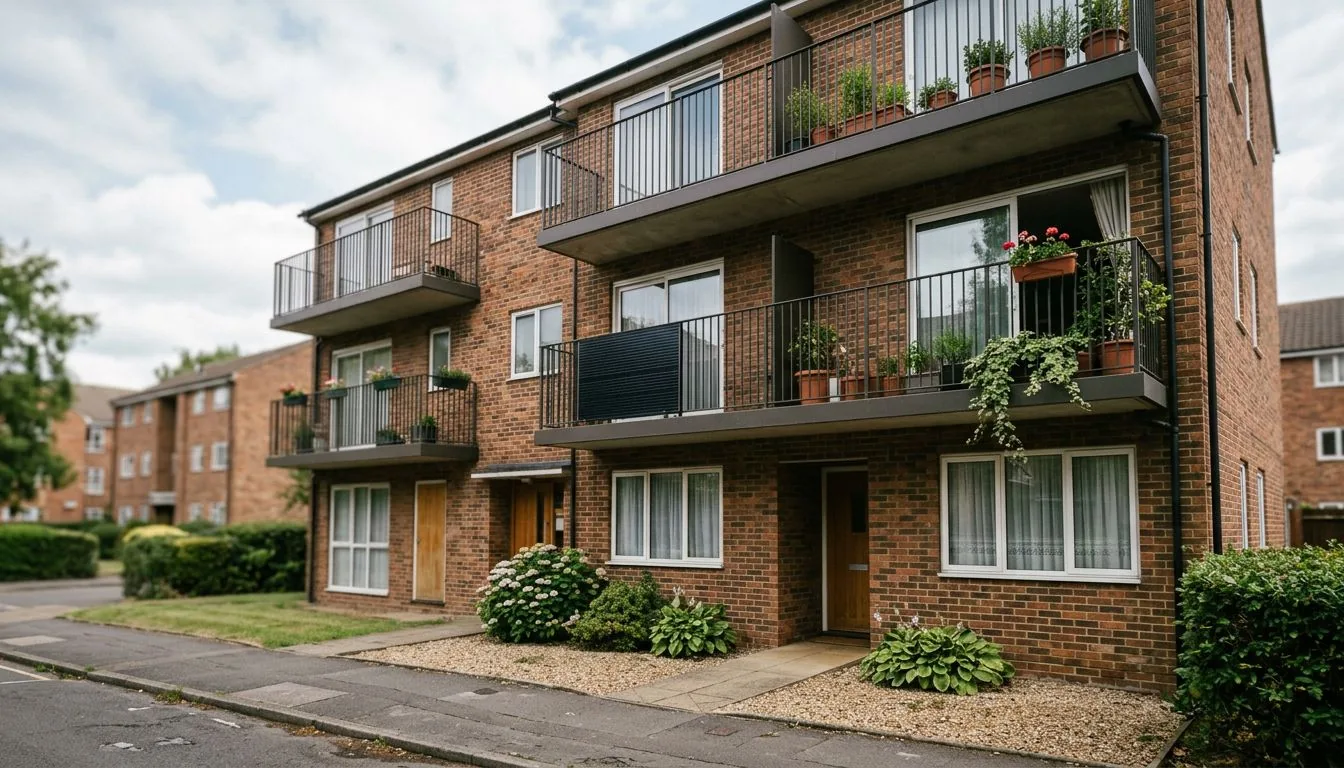
Balcony solar panels in the UK have gone from a curiosity to a legal option. Flats used to be locked out of solar, because the roof belongs to someone else. However, a small plug-in kit can sit on a balcony and feed your own sockets.
This guide explains how solar panels for flats work in the UK. It covers the rules, the consent you need, and what a balcony kit can realistically produce.
Quick answer: can flats have solar panels?
Yes, in two ways. You can fit a plug-in kit on a balcony or wall, or you can share in a system on the building’s roof. The first is quick and cheap. Meanwhile, the second depends on your freeholder.
Since 27 August 2026, plug-in solar kits of up to 800 W output can legally be plugged into a normal socket in Great Britain. However, you must tell your network operator, use only one kit per home, and never use an extension lead.
Why flats are harder
In most cases a flat has no roof of its own. The freeholder or management company owns the roof and the outside walls. So a flat owner usually cannot put panels there without a formal agreement.
Renters face a second hurdle. The landlord owns the home, and the lease or tenancy may ban changes to the outside. As a result, consent comes before everything else.
Balcony solar: how the legal kit works
A plug-in kit has panels, a small inverter and a plug. The inverter turns the panel’s direct current into household power. Then you plug it into a socket, and the power flows into your home.
The rules come from SI 2026/848. Here are the main limits:
- The maximum AC output is 800 W.
- The panels’ total rating cannot exceed 2,000 W.
- Above 960 W of panels, the maker must advise a professional wiring check.
- You must notify your network operator, normally within 28 days (G98 process).
- You need RCD or RCBO protection, and no extension leads.
Our guide to plug-in balcony solar kits goes deeper on the kit rules. You can also read about DIY solar in the UK to see where the legal line falls.
Sources: SI 2026/848 on legislation.gov.uk; DESNZ plug-in solar government response, July 2026.
What a balcony kit can produce
A balcony panel hangs on a railing, so it is nearly vertical. That costs output. For instance, using the EU’s PVGIS solar model for London, 1 kWp of south-facing panels at a 35° tilt makes about 1,025 kWh a year. The same panels hung vertically make about 746 kWh, or 73% as much.
Direction matters even more. Vertical panels facing east or west make only about half the south-facing figure, roughly 520 kWh per kWp in London. So a south-facing balcony is worth much more than one facing sideways.
Angle is a cheap fix. For example, a frame that tilts a panel to 60° lifts a south-facing balcony panel to about 96% of the 35° figure. Our guide to the best angle for solar panels explains this in full.
A worked example
Take a 0.8 kWp balcony array facing south in London. At 746 kWh per kWp, it makes about 600 kWh a year. At the Ofgem price-cap average of 26.32p per kWh (October to December 2026), each unit you use yourself saves that much.
In the best case, using all 600 kWh would save about £157 a year. In practice, you will not use every unit, because the kit produces power while you may be out. So treat that figure as a ceiling, not a promise.
Sources: PVGIS v5.2 (EU Joint Research Centre), SARAH2 database, 14% losses; Ofgem price cap, October to December 2026.
Will you be paid for exports?
Probably not. The Smart Export Guarantee needs an MCS-certified installation and installer. A plug-in kit you fit yourself does not meet that test. So its value lies in the electricity you use directly.
If you want export income, you need a certified system. A typical 4 kWp roof system costs about £6,500–£8,500 fitted (October 2026), which is far beyond a balcony kit. Our overview of solar panel systems for homes shows how full systems work. Check our solar grants guide for any support that might apply before you commit.
Planning rules for flats and balconies
In England, plug-in solar is now treated as solar PV for planning. A balcony enclosure such as a railing or parapet can carry panels that protrude no more than 200 mm if it abuts a highway, or 400 mm otherwise.
However, there are firm exceptions:
- Plug-in solar is not permitted development on a wooden wall or balcony, or on timber cladding.
- Listed buildings are excluded.
- Conservation areas have extra limits on elevations that face a road.
- Blocks of flats follow separate permitted development rules.
Check with your council, because the rules turn on your exact building. Our guide to when solar needs planning consent covers the detail. Scotland, Wales and Northern Ireland have their own planning rules.
Sources: SI 2026/896 on legislation.gov.uk.
Leasehold and rented homes
First, check your lease. Many leases forbid changes to the outside of the building, and a balcony often counts as part of that. So ask your freeholder or managing agent in writing before you buy anything.
The government says renters and leaseholders should get landlord or freeholder consent first. Also, keep the approval on file. If you move, a plug-in kit can usually come with you, so it suits renters better than a fixed system.
Building insurance is another point to raise with the freeholder. So ask whether a kit changes the policy.
A shared roof system
The bigger prize is a roof array for the whole block. That is a freeholder decision, often needing agreement from all leaseholders. If your block is considering it, a certified installer can quote for the building. Our guide to how big a solar panel is helps you judge whether the roof has space. A typical panel is about 1.76 m by 1.13 m and weighs about 22 kg.
Help for lower-income and social housing tenants
If you cannot pay upfront, look at support. ECO4 closes on 31 December 2026, so do not plan around it. However, the government’s Warm Homes Plan (January 2026) promises low- and zero-interest loans for solar, plus funded installs for low-income households. Most schemes open from 2027.
Your council may also run a Warm Homes: Local Grant for low-income households in England. Ask them directly. Our guide to free solar panel schemes shows which offers are real.
Flats in London and Manchester
City flats have their own pattern. For example, London flats often sit in conservation areas and terraces, and London yields about 1,025 kWh per kWp for south-facing panels at 35°. See what solar generates in London for details.
In the north, yields are lower. For instance, Manchester makes about 885 kWh per kWp on the same basis. Our page on Manchester solar costs and support covers local points.
Northern Ireland
The plug-in rules rely on regulations that do not extend to Northern Ireland. The legal position there is unverified, so check with your network operator before buying a kit.
Frequently asked questions
Can I put solar panels on a flat balcony?
Yes, in Great Britain, if you use an approved plug-in kit of up to 800 W and have consent from your landlord or freeholder. You must also notify your network operator.
Do I need planning permission for balcony solar panels?
Often not in England, because plug-in solar now counts as solar PV for permitted development. However, it is not permitted on wooden balconies or timber cladding, or on listed buildings. Check with your council.
Can renters have solar panels?
Yes, with the landlord’s consent. A plug-in kit is easy to remove, so renters can take it with them when they move.
How much will a balcony solar panel save me?
It depends on direction and use. A south-facing 0.8 kWp array in London makes about 600 kWh a year, worth up to about £157 at the current price cap if you use every unit. East or west facing balconies make about half as much.
Will I get SEG payments for balcony solar?
Probably not. The Smart Export Guarantee needs an MCS-certified installation and installer.
Next step
If your building allows a full system, a certified installer can assess it. Request free quotes and we will connect you with installers near you.