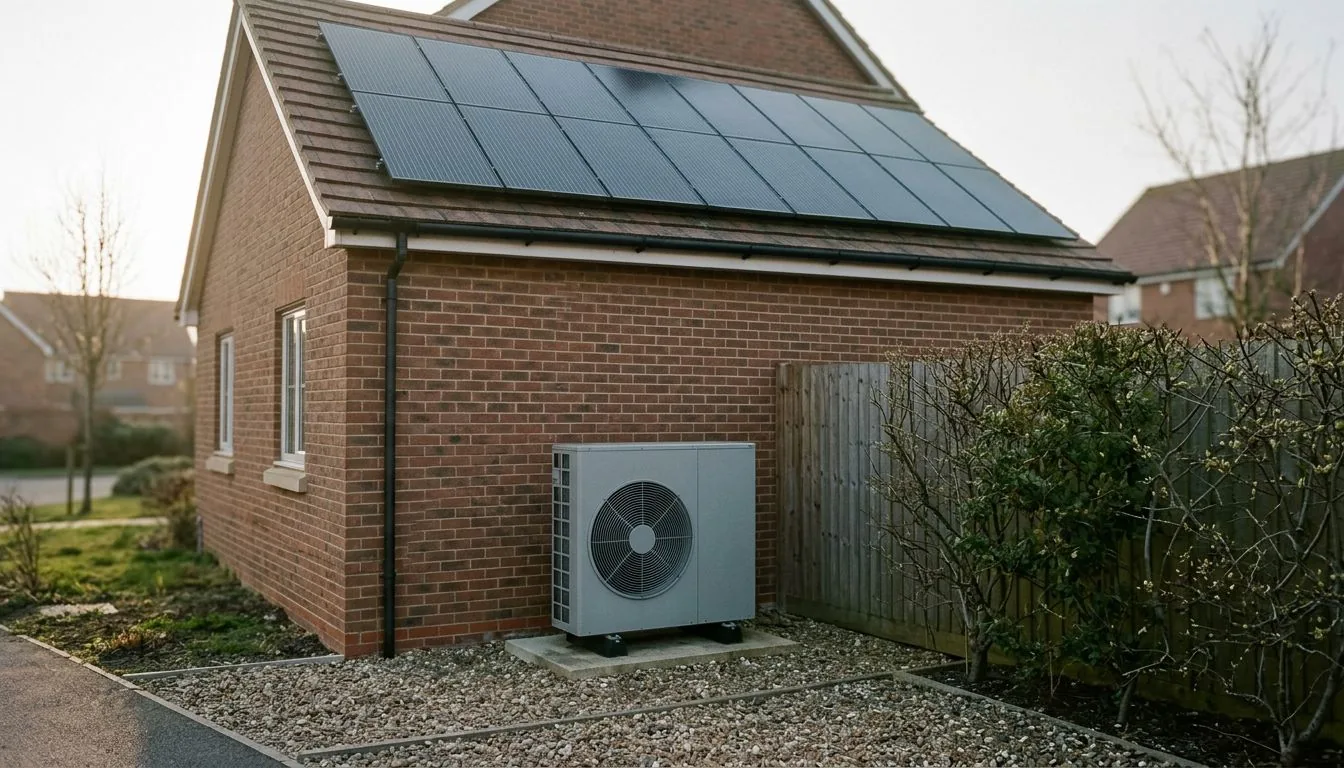
Solar panels for heat pump homes are a popular pairing, because a heat pump turns electricity into heat. This guide shows how many panels you need, what they will cover, and why winter is the hard part. All figures are UK averages and estimates, so treat them as a starting point.
How much electricity does a heat pump use?
A heat pump in a typical home uses roughly 3,500 kWh of electricity a year, with a plausible range of 3,000–4,500 kWh. That is more than the 2,700 kWh the rest of the house uses. However, this is an estimate, not a measured figure for your home.
Here is where the estimate comes from. Ofgem’s medium gas figure is 11,500 kWh a year. Assuming a boiler about 85% efficient, that gives roughly 9,800 kWh of heat. Real-world monitoring of 742 UK homes found a median efficiency of 2.8: about 2.8 units of heat per unit of electricity. Divide 9,800 by 2.8 and you get about 3,500 kWh.
A typical UK home uses about 2,700 kWh of electricity a year (Ofgem’s medium figure). Add a heat pump and the total rises to roughly 6,200 kWh. That number drives the sizing below, because it sets the target for your panels.
Sources: Ofgem typical domestic consumption values and Energy Systems Catapult on the DESNZ heat pump demonstration.
Solar panels for heat pump systems: how many do you need?
To match a year’s electricity, you need panels that generate about 6,200 kWh. For a typical UK roof we assume about 900 kWh per kWp a year. Therefore you need around 6.9 kWp, which is 15 to 16 panels at 430–450 W each.
The table shows what different sizes would produce, while the share column compares annual generation with the 6,200 kWh total.
| System size | Panels (430–450 W) | Yearly output | Share of 6,200 kWh |
|---|---|---|---|
| 4 kWp | 9–10 | about 3,600 kWh | about 58% |
| 5 kWp | 11–12 | about 4,500 kWh | about 73% |
| 6 kWp | 13–14 | about 5,400 kWh | about 87% |
| 7 kWp | 15–16 | about 6,300 kWh | about 100% |
A south-facing roof in southern England can manage 1,000 kWh per kWp or more, whereas a shaded or east-west roof in the north may give nearer 750–800. Adjust the table accordingly.
Matching annual totals is a sizing guide only. You will not use all that output yourself, because much of it arrives in summer and at midday. For more on method, see sizing a system to your usage.
What a 4 kWp system covers
Many homes have room for about 4 kWp. A system that size makes about 3,600 kWh a year, which roughly equals the heat pump’s yearly use on its own. However, it will not meet all of that demand directly.
Think of it this way. Summer sun is plentiful, but a heat pump does little in summer, apart from hot water. In winter the heat pump works hard, yet the panels produce least.
So a 4 kWp system lowers your bill across the year, but it leaves most winter heating to the grid. Our overview of how a domestic solar system fits together explains the pieces involved.
The winter problem
Solar output and heat demand peak in opposite seasons, which creates the main difficulty. About 60–70% of heat demand falls from November to March (an estimate). In those months, London yields only about 37–68 kWh per kWp a month, against 110–125 kWh in summer.
December output is roughly a quarter to a third of June’s. In Glasgow it is under a fifth. For example, in London a 4 kWp system makes about 150 kWh in December, against about 490 kWh in June.
A heat pump might use 400–500 kWh in a cold winter month, on our estimate. Therefore, in December even a 4 kWp system covers only a fraction of that month’s heating, and none of it after dark.
Solar covers only a small share of a heat pump’s winter demand. As a result, size panels for annual use, and look at a battery or time-of-use tariff for winter.
Sources: PVGIS monthly yields for south-facing panels at 35°, as at October 2026.
Does location change the answer?
Yes, both for heat demand and for sunshine. Colder regions need more heating, but they get less winter sun. Using the EU’s PVGIS solar model, 1 kWp of south-facing panels at a 35° tilt in Leeds produces about 945 kWh a year, so a 4 kWp system makes about 3,800 kWh.
In Scotland, yields are lower and winters are longer, so the gap is wider. See our page on solar panels in Scotland for local figures, and Leeds solar costs and support for a northern English example.
The practical lesson is simple. In colder, darker places, add a little extra capacity if the roof allows, since winter output is so low.
These figures are for south-facing panels at 35°, from PVGIS. Real roofs that face another direction, are shaded or are badly tilted produce less.
Will a battery help?
A battery stores spare daytime power for the evening. It helps most when demand falls after the sun has gone. Adding a 5 kWh battery at the same time as the panels typically adds £2,500–£4,000.
On a flat-rate tariff, a battery lengthens payback. For example, on our standard model, a 4 kWp system with a 5 kWh battery raises the annual benefit to about £740, but payback stretches to about 15–16 years. Batteries pay back faster if you use a cheap overnight tariff, which this model leaves out.
Therefore a battery is not essential for a heat pump. It becomes more attractive if you can charge it cheaply overnight. Read about solar battery storage costs and benefits before you decide.
Sources: HMRC VAT guidance on batteries.
What does it cost, and does it pay back?
A typical 4 kWp system costs about £6,500–£8,500 fitted (October 2026), while a 6 kWp system costs about £9,000–£11,000. These prices include 0% VAT, which ends on 31 March 2027. After that the rate goes to 5%.
On our standard model, a 4 kWp system costing about £7,500 saves and earns roughly £590 a year at October 2026 prices. That means it pays for itself in about 13 years, or roughly 11–15 years depending on price, roof and export tariff. See the solar payback period for the workings.
A heat pump can improve the picture, since panels save the most when you use the power yourself. Each self-used kWh is worth the import price. Under the Ofgem price cap for October to December 2026, electricity costs an average of 26.32p per kWh. At that rate, 3,500 kWh of heat pump electricity would cost about £920 a year if bought entirely from the grid.
By comparison, Ofgem’s medium gas figure of 11,500 kWh at 7.97p per kWh costs about £917 a year, before standing charges. Rates are reviewed quarterly, so these will change.
Sources: Ofgem price cap, October to December 2026 and DESNZ solar PV cost data.
Do you have the roof space?
Space often decides the size, because panels need room. A typical home panel is about 1.76 m by 1.13 m, weighs about 22 kg and is rated at around 430–450 W. A 4 kWp system needs 9–10 panels and about 18–20 m² of roof.
That means 7 kWp needs roughly 32–35 m², which many roofs cannot offer. If space is tight, however, higher-efficiency panels help. Check solar panel sizes and dimensions before planning.
Another option is a ground-mounted array or a second roof face. Either way, ask your installer to design around your real roof.
Is it worth combining them?
Often yes, but it is a trade-off. Solar cuts the cost of running a heat pump, and a heat pump gives your panels more electricity to use. However, winter demand will still come mostly from the grid.
Weigh the benefits against the costs, using the advantages and disadvantages of going solar. The government’s Warm Homes Plan, published in January 2026, promises low- and zero-interest loans for solar, batteries and heat pumps. Most of those schemes open from 2027, so check gov.uk before applying. Our solar grants guide explains which schemes are open and who can claim.
To size a system for your own roof, try our guide that helps you estimate your system size with the calculator. Then, if you want prices, our free quote form connects you with local installers.
Frequently asked questions
How many solar panels do I need for a heat pump?
To match a year’s use for a typical home, you need about 6–7 kWp, which is roughly 14–16 panels. A 4 kWp system of 9–10 panels covers a large share of the heat pump’s yearly use, but little of its winter demand.
Can solar panels run a heat pump on their own?
Not through winter, because panels produce least when a heat pump works hardest, and nothing at night. Most homes still draw winter heating power from the grid, even with a large array.
Do I need a battery with a heat pump and solar panels?
No, but it can help. A battery moves spare daytime power to the evening. However, on a flat-rate tariff it lengthens payback, so it suits homes that can also charge cheaply overnight.
How much electricity does a heat pump use?
Roughly 3,500 kWh a year in a typical home, based on an estimate from gas use and a real-world efficiency of 2.8. Your figure depends on your home’s size, insulation and heating needs.
Is it better to fit solar panels before a heat pump?
Either order works. Fitting panels first starts the savings sooner, although a heat pump will raise your usage later. If a heat pump is coming, tell your installer so they can size the panels for the extra load.