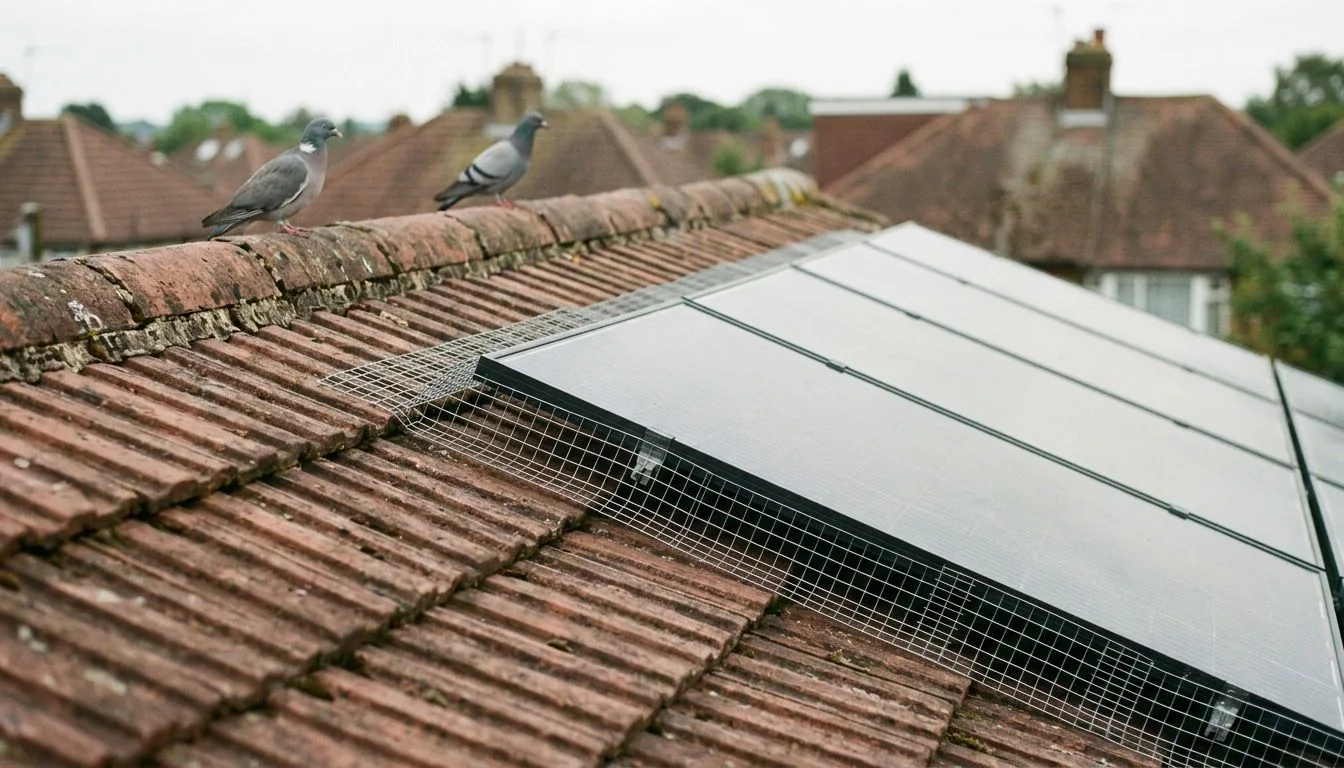
Pigeon proofing solar panels is one of the most useful jobs you can do to protect a roof system. Birds love the warm, dry gap under the panels. Once a pair settles in, they usually come back every year.
This guide explains the damage pigeons cause and compares the main methods. It also covers cost, the law on nests, and when to call a professional.
Why pigeons nest under panels
Panels on a pitched roof leave a sheltered space between the glass and the tiles. The gap keeps out rain and wind, and it is hard for predators to reach. For a pigeon, it is a near-perfect nest site.
As a result, the problem tends to grow. A pair returns each breeding season, and other birds follow. Left alone, the mess, noise and damage get worse.
The damage pigeons can cause
Birds under the panels can cause several problems:
| Problem | Why it matters |
|---|---|
| Droppings on the glass | Dirt can block light and cut output |
| Nest material under the panels | It traps debris and can restrict airflow |
| Pecking or nesting near cables | Damaged wiring is a safety risk |
| Damp and mess on the roof | It can harm tiles, felt and timber |
| Noise and smell | It affects your home and neighbours |
We do not quote a percentage loss here, because no reliable UK figure exists. Instead, watch your monitoring app. A sudden drop in output with no clear cause can be a sign of a problem.
Some manufacturers and insurers also treat pest damage differently from normal wear. For that reason, check your warranty and policy wording.
Pigeon proofing methods compared
There are four main approaches. They are not equally effective.
Mesh. Wire or UV-resistant mesh fits around the edge of the array and clips to the panel frames. It closes the gap completely, so birds cannot get in. Most installers regard it as the best option.
Spikes. Spikes along ridges and edges stop birds from landing. However, they do not stop nesting under the panels, so they work best as an extra measure.
Tensioned wires. Thin wires make perching awkward. They look neater than spikes, but they are less reliable at keeping birds out of the gap.
Decoys. Plastic owls and hawk kites seldom work for long, because pigeons soon learn to ignore them.
| Method | How well it works | Best use |
|---|---|---|
| Mesh | Very good | Primary protection |
| Spikes | Limited | Back-up on ridges and edges |
| Tensioned wires | Moderate | Neater edge deterrent |
| Decoys | Poor | Not recommended |
What it costs
The price depends on the size of the array, the number of panels and how easy it is to reach the roof. Scaffolding or other access can add to the bill. For this reason, ask for a fixed quote rather than a per-panel guess.
The cheapest time to do it is when the panels go on. If you are still planning, ask each installer to include mesh in the quote, and compare solar panel installation costs on that basis. For the wider picture of prices, see our guide to solar panel costs and savings in the UK.
If you already have panels, a solar maintenance company or a pest control firm can fit mesh as a separate job. Most use clips that attach to the panel frame without drilling.
Professional work or DIY
Roof work is dangerous, and falls cause serious injuries every year. Unless the panels are on a low, easy-to-reach roof, hire a professional. In addition, you will need safe access, which can cost as much as the mesh.
DIY kits exist, but weigh the savings against the risk and the cost of safe access. If you are unsure, ask a professional to look first.
If pigeons are already nesting
Wild birds are protected. Under the Wildlife and Countryside Act 1981, it is an offence to take, damage or destroy a nest in use or being built. So do not disturb a nest while it holds eggs or chicks.
Wait until the birds have finished. Then have the nest cleared and the mesh fitted straight away, because delay invites the birds back. Ask a licensed pest controller if you are unsure of your position.
Sources: Wildlife and Countryside Act 1981.
Part of regular maintenance
Mesh is not a one-off job. Check it each year when you clean the panels, as part of your usual solar panel cleaning and maintenance. Look for gaps, loose clips and new nesting activity.
Good protection also helps you keep the system healthy for decades. See how long solar panels last for more on protecting the wiring and the panels.
Where pigeons are most common
Pigeons are most common in towns and cities. If you live in a big city, local guides such as London solar costs and support and Birmingham solar costs and support show what is typical for your area. Solar panels in Manchester is another city guide worth a look. Flat roofs can have the same issue, so see solar on a flat roof too.
Are you buying a home that already has panels? Check for signs of nesting before you buy. Our guide to buying a house that already has solar panels lists what to ask. For a full home system, read about home solar panel systems explained.
Frequently asked questions
Will mesh damage my panels or roof?
Good mesh uses clips that grip the frame, so no drilling is needed. Fitted correctly, it does not harm panels or tiles. Avoid any system that needs holes in the panel frames.
How do I know pigeons are nesting under my panels?
Listen for cooing from the roof. You may also see droppings and feathers below the array, or nest material in the gutters. A drop in output with no other cause is another clue.
Can I claim for pigeon damage on my insurance?
It depends on your policy. Some cover pest damage, but many exclude it or add conditions about maintenance. Check your wording before you make a claim.
Is there a grant for pigeon proofing?
There is no specific grant. It is a maintenance cost that protects your investment. However, it is much cheaper to include it when the panels are first fitted.
When should I fit mesh?
Ideally at installation. If you already have panels, fit it once any nest is clear and the birds are no longer breeding.
Planning a system? Get free quotes and ask installers to include bird protection.